Author: Mohammad Amin

  • Why would you need a president & secretary to run a football club?

    Why would you need a president & secretary to run a football club?

    Mohun Bagan once epitomised tradition, fair play, dignity and virtues, but today those are missing from their iconic status as one of the leading Indian football clubs.

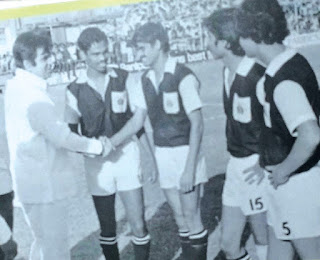
    It can be recalled that in the 1970s when a few footballers refused to take part in a tournament, the then club secretary Dhiren Dey declared that Bagan would field its groundsmen.

    That was the spirit and values the club stood for, but that seems to have vanished.

    The factional politics has done more harm to its image in recent months just like it did in 2004-05.

    This time the club’s Executive Committee has resigned en masse to protest against Anjan Mitra and his inefficiency. The club has lost McDowell as its sponsor, and what stands today is all about misery and false ego.

    There’s no need to crib and cry over its doomed fate as Bagan and the other two – East Bengal and Mohammedan Sporting – has seldom understood the importance of professionalism.
    If a tournament like ISL has spread its wings, it’s because these clubs have boosted their confidence by being inactive and less ambitious.

    Prashanto Banerjee, one of India’s finest midfielders and who led Bagan in 1988, once told me that the difference between East Bengal and Bagan is that politics is less significant in the former club.

    A player like Subroto Bhattacharya who played only for Bagan during his 17 year career, knows more about the club’s politics than most people. Having coached Bagan to two National League titles and couple of other major trophies, he doesn’t mince his words when it comes to politics in Bagan.

    It’s not about who is right or wrong here, but there has to be an integrity and accountability when you run an institution like Bagan.

    The club, like East Bengal and Mohammedan, is still not a private entity. We don’t have to compare European clubs with ours because that would be a chalk and cheese difference.

    Just watch how Bengaluru FC became one of the top sides in the country. This southern club should be one of the best examples of a professional modern club.

    We really don’t understand why would you need a president or secretary and cronies to run the club or you’ve to be north Calcuttan or East Bengalis or Bihari Muslims to link your identity with the respective clubs?

    Bagan that once united a race to fight against foreign rule, has now been reduced to a society of people with blinkered vision and overriding political ambitions.
    http://footballwallah.blogspot.qa
  • Important is to respect all sports, not just cricket

    Important is to respect all sports, not just cricket

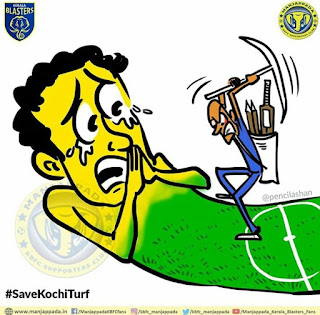
    It’s unfathomable why a football ground has to be dug up to play cricket in India.
    The BCCI decision to award an ODI between India and West Indies at Kochi has come under serious criticism.

    The match, scheduled for November 1, is set to clash with season 5 of the Indian Super League (ISL).
    We’ve to understand that football is still a secondary sport in the country given cricket’s massive influence on the economy. It churns out money for BCCI and various stakeholders.
    Also, there’s absolutely no hard feelings towards the sport or players, who play cricket. But why every time a football venue, which has been so well nurtured and maintained before the U17 FIFA World Cup, has to be sacrificed for cricket’s benefits.
    Several footballers, officials and even a political personality like Shashi Tharoor took to the social media to blast those who are willing to uproot the goalposts and midfield at Kochi’s Jawaharlal Nehru Stadium, also the home of ISL side Kerala Blasters.
    “Spoke to CoA Chief Vinod Rai to denounce Kerala Cricket Assn’s bizarre decision to transfer the India-WI ODI from a match-ready Trivandrum stadium to Kochi, whose ground was last used for the U17 Football World Cup. He has promised to review the matter. KCA motives highly suspect,” tweeted Tharoor on Monday.
    The JN Stadium is one of only six stadium that are FIFA approved, a certification that will take immense effort to obtain again.
    “Wouldn’t have said anything if things were that simple. It’s not one pitch, but FIVE, according to ICC rules. That is, midfield gone. They didn’t repair the turf all through ISL first season. The stadium belongs to a realtor agency who doesn’t give two hoots for the game,” wrote noted Malayalam writer N S Madhavan.
    The emotions have poured in on the social media by fans, footballers and others. But is that enough to put pressure on the KCA or BCCI to change their decision, is anybody’s guess.

    http://footballwallah.blogspot.qa/

  • Amal Dutta: The Diamond of Indian Football

    Amal Dutta: The Diamond of Indian Football

    July 10, 2016. It was late evening at Hyderabad’s Rajiv Gandhi International Airport when a message from an acquaintance in Calcutta flashed across my phone:

    “Amal Dutta has passed away.”

    During my career as a football journalist, I had met him only twice. Before meeting him in 2015, we had spoken once over the phone from Delhi’s Indian Express office—back in the halcyon days of sports journalism, when athletes and coaches had no qualms about being interviewed over the phone.

    I had first contacted Amalda in the summer of 2002 for a topic only he could do justice to—India’s failure to qualify for FIFA World Cups, contrasted with China’s maiden entry onto the global stage in 2002. The following year, I met him briefly in Calcutta during a posting. As a journalistic courtesy, I had couriered him a copy of the Indian Express.

    What struck me most was his generosity and humbleness. Months later, I received a hand-written letter from him recalling our interview. I was thrilled—no other athlete I had interviewed had ever taken such care. Amal Dutta was an exception. He was a true gentleman.

    As a coach, his mind was extraordinarily creative, arguably even sharper than that of his contemporary and rival, Pradip Kumar Banerjee (PK). Amalda never shied away from experimentation. He never wanted his teams to play dull, drawn-out games. In his own words:

    “The beautiful game must look attractive and beautiful.”

    Beyond the goal, he treated football as an art form.

    It has been a year since Amal Dutta left us. Somewhere above, I like to imagine, he is still sketching team formations in his notebook.

    In July 2015, I visited him at his Baguihati residence in Calcutta to compile a chapter for my book. For three hours, he spoke with the calm intensity of a man who lived and breathed football:

    “For me, a football team is like a society. Everyone must contribute to its development. The Diamond System was designed to utilize every player when we attacked,” he explained.

    He was the Euclid of Indian football, with a mind that extended far beyond the pitch—into literature, physiology, and music. Amal Dutta understood the flaws in Indian football, but few were willing—or able—to listen. His formations and ideas were decades ahead of their time.

    His Diamond System, implemented at Mohun Bagan in 1997, made him a household name. Immediately, he was hailed as a true thinker—a tactician who could translate ideology into play.

    “I derived the idea from Total Football,” he said. “If everyone contributes a little in a family, it strengthens the household. Football is the same—everyone must contribute.”

    A caring mentor, he nurtured young talent from scratch, much like Achyut Banerjee, Bagha Shome, and Sir Dukhiram before him. I still remember him patting the highly temperamental Chima Okorie, calming him after tears flowed following Bagan’s 1–3 defeat against FC Kochin in the 1997 Durand Cup final at Delhi’s Ambedkar Stadium.

    After his era ended, Calcutta clubs largely discarded homegrown tacticians in favor of foreign coaches. Even though Indian coaches are experiencing a revival today, the damage had already been done—careers and potential lost.

    Amal Dutta was never given his due by Indian football. After the 1986 Nehru Cup, he was never recalled to the national team. The AIFF, dependent on borrowed ideas, ignored his brilliance and denied him the chance to guide India’s grassroots programs.

    Yet he cared little for their approval. His innovations always sparkled—sharp, brilliant, and unforgettable, like a diamond.

    Amal Dutta was more than a coach. He was a guru, a visionary, and the true architect of Indian football.


  • Mohammad Farid: Hyderabad’s last top star

    Mohammad Farid: Hyderabad’s last top star

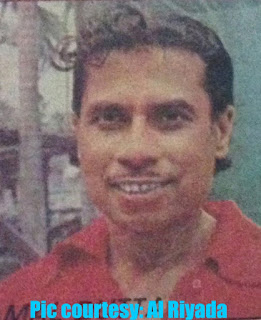
    At a wedding reception in Rampur, Uttar Pradesh, nearly a decade ago, one of the guests struck up a conversation with me. “You’re from Calcutta, so you must know Mohammad Farid,” he said. “He’s my first cousin—and he was a footballer.”

    When I told him that Farid, now 58, had been among the most popular footballers of the 1980s and early ’90s, he looked genuinely surprised. 

    He admitted that the family had never really followed Farid’s career, largely because there wasn’t much interest in football at home.

    “We really didn’t know about his achievements and, that he also played for India,” he added. 

    Not just him—in fact, most people outside Calcutta either never knew or have long forgotten this unassuming former attacking midfielder. 

    One reason is the near absence of material about him online, barring a few yellowed pages of old Bengali football magazines.

    Farid began his senior career with Hyderabad City Police in 1974 and played there until 1977 before moving to Calcutta.


    Despite enjoying a glittering career with Mohun Bagan, East Bengal and Mohammedan Sporting, he chose to remain away from the limelight after retirement. He finally hung up his boots in 2000, representing his office team, the Food Corporation of India (FCI).

    The purpose of this blog is to chronicle his 19-year journey in Calcutta football and to introduce a new generation to a gutsy, skilful player who holds a rare distinction—Mohammad Farid was the last footballer from Hyderabad to represent all three of Calcutta’s iconic clubs.

    His fans in Bengal still remember his last-minute goal
    against Nepal in the 1987 SAF Games football final while some post old
    photographs from some of his outstanding performances on the Facebook.

    “One of my friends introduced me to Facebook recently, and it felt wonderful to reconnect with fans and former team-mates,” he said. “I never thought of telling the world about my achievements. It never seemed necessary—the love and admiration from fans and team-mates were always enough. But thanks to Facebook, I’m now flooded with friend requests from supporters I don’t even know,” he added, a quiet surge of pride evident in his voice.

    Farid also represented
    the country at the Kings Cup (Bangkok, 1981), UAE friendlies matches (Dubai, 1981),
    Presidents Cup (Seoul, 1982), Asian Games (New Delhi, 1982), Nehru Cup
    (Calicut, 1986) and SAF Games (Calcutta, 1987).

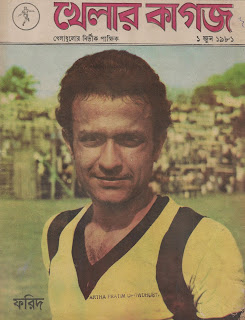
    I saw his cover photo on a popular Bengali magazine Khelar Kagoj after he joined East Bengal
    in 1981, but met him for the first time last year at our common relative’s
    place at Mehdipatnam, Hyderabad.

    So, how did he land up in Calcutta?

    “In 1980, I was selected for the senior national team for
    the 1982 Asian Games. The preparation had started two years before at the
    insistence of former Prime Minister Indira Gandhi. The camp was held at Salt
    Lake Stadium. We were put up at Karunamayee,” said Farid, who was born on July
    7, 1959. 

    His coy and sober nature was always appreciated while his
    grit and determination were his assets on the field. 

    “One day, the then East Bengal football secretary took me to
    a south Calcutta flat where I was offered to join them. Later, they kept me at
    Hotel Bliss at Ekdalia Road. They released me only after I had signed a
    contract. I was just 20 then.”

    That’s how Farid’s journey to the City of Joy started. He
    was lucky to have played alongside star Hyderabadis Mohammad Habib (in EB),
    Victor Amalraj (EB, MS and MB) and Shabbir Ali (MS).

    Farid performed with such steel and style that he remained a
    top catch for all the clubs in those golden years in Calcutta.

    “I left East Bengal and joined Mohammedan in 1983, but
    switched to Bagan the next year,” he said.

    In fact, Farid, whose real name is Shazore Alam Khan, had
    his best stint at the green and maroon club.

    Those three years were the most enjoyable one in my career.
    I’ve had a very good experience at Bagan. I won’t ever forget Mr Dhiren Dey’s
    love and respect for the players. 

    “He had a style statement and never spoke in Bengali. He
    used to address me as ‘Mr Farid’. There was no delay in payment and the club
    used to give me to-and-fro airfare to Hyderabad. It was a huge encouragement,” reminisced
    Farid, who rejoined Mohammedan in 1987 on a five-year contract.
    Today, Calcutta is his home where he divides his time
    between his job at FCI and, in the evening gives free coaching at Salt Lake’s
    DL Block to poor kids from Keshtopur since 1992.
  • Jo Jeeta wohi Sikander

    Jo Jeeta wohi Sikander

    Syed Nayeemuddin always loved to stay at Hotel Bombay Orient,
    opposite to Karims in Old Delhi.
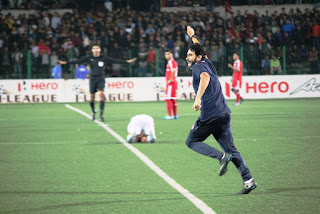
    Khalid Jamil exults after the final whistle. 
    Even when he was the national team coach, the Hyderabadi
    preferred no-star accommodation to the five-stars because he loved food at the Karims.
    Nayeem was in Delhi to watch the 1997 Durand Cup and pick
    few players for the Kathmandu SAFF Cup.
    It was at the Hotel Bombay Orient that I had met a rookie
    Mahindra United midfielder Khalid Jamil, who maintained a calm demeanour at the
    table as the Dronacharya spoke to him on his mistakes in one of the Durand
    matches.
    Aisa khel. Focus
    kar,” Nayeem told a young Khalid.
    The Kuwait-born player nodded his head — his talent and
    shyness probably attracted the former coach to include him for the Kathmandu-bound squad.

    Doodh pio. Bina shehat
    ke footballer nahin ban sakte
    (Drink milk. Without a good physique, you can’t
    become a strong footballer),” added the Hyderabadi.   

    Nayeem knew Khalid had talent to become an effective midfielder.
    His height was an advantage, and if he would develop his physique, he will be
    difficult to beat in the middle.
    After a couple of good seasons with Mahindra, Air India and national
    team, Khalid’s recurring knee injuries him to cut short his international career
    in 2004.
    He continued to play in the domestic league and played for
    Mumbai FC in their first season, where they finished sixth in the 2009 I-League,
    but injuries troubled him.
    It was then the team’s head coach David Booth put Khalid in
    charge of Mumbai’s Under-19 side which won the title.
    That was the start of a marvelous journey as a coach and
    today the 40-year-old is one of the best young coaches in the country.
    His success as Aizawl FC head coach on Sunday would go down
    as one of the amazing feats scripted in Indian football.
    Whatever little conversations we had during his formative
    years two decades ago, I found him one of the quietest among the Indian players.

    Some writers compared him with Nayeem as someone who maintains
    a stoic silence, but his silence played a crucial role in his coaching career
    when he managed Mumbai FC for seven years on a shoe-string budget.

    Khalid never complained neither left the ship like any other top professional coach would do. 

    He hanged around there before taking up the job at the
    North-East club this season. Those seven years, in fact, was the beginning of his
    impressive coaching career. 
    Way to go, Khalid. 
  • All India Football Reliance

    All India Football Reliance

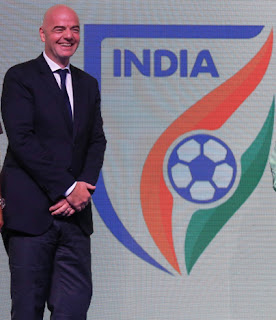
    FIFA President Gianni Infantino. 
    So, someone who’s allegedly linked to a
    ‘cricket’ corruption can also pick a national ‘football’ coach?

    The day I posted it on my FB timeline, there
    were few likes from some journalists, ex-footballers and football lovers.

    The recent juggling of the various AIFF
    committees and sub-committees may force us to rethink if PP and Co. are really
    serious about the sport in India after they officially included its marketing
    partners in important decision-making bodies.

    It’s also rare for commercial partners or
    sponsors to be given decision-making roles in national sports federations, but
    why AIFF has allotted the spaces to some including one, who was
    allegedly involved in cricket’s IPL corruption in 2013, is anybody’s guess.

    I had an interesting chat on the topic with one
    of the senior journalists, who had covered more cricket than football.

    He defended AIFF and blasted the top Calcutta
    clubs for having killed the game.

    “If R is pushing the cash in the game, won’t
    they want their men to handle the show. Isn’t it obvious? It’s better than pozi
    cash coming to the clubs in gunny sacks. If the Indian Super League is drawing
    crowds and getting sponsors, why rant?” he asked.

    I’ve no issues with money being pumped into the
    sport, but interference from sponsors is unwarranted. We also can’t rule out
    their demoniacal presence in the multiple committees.

    Do we see Barclays’ people in the Premier
    League management or FIFA being guided by their commercial partners? If a
    franchisee sells chicken burgers to its clients, it doesn’t mean it has the
    right to sell football too just because it’s sponsoring some events.

    When I told my journalist friend that Shyam Thapa,
    who will now head the new technical committee, have a better technical acumen
    than someone from cricket, he chucked, “Thapa is a dead wood. He doesn’t even
    follow modern football. I consider PP a double dead wood. So let’s flow with
    the tide.”


    My friend supported the idea of having people
    from the commercial partners, but didn’t want Thapa. 
    I really got confused with his unbalanced
    opinions, but I can’t blame him because anyone will find it difficult to solve
    this tricky AIFF theorem.

    Meanwhile, the two top Bengalis in the federation — one non-resident and the other original — batted in favour of SR. They’re Indian football’s ‘Johor-Bhanu’ — Bengali films all-time famous comedians.


    It was also funny to read one of their comments, “Everything is related to commercial exploitation. We wanted an outsider to tell us, with his BCCI experience, how we can actually improve the technical committee’s decision making.”
  • It’s difficult to forget the years in Calcutta: Amalraj

    It’s difficult to forget the years in Calcutta: Amalraj

    Amalraj introduces Mohammad Akbar, Surajit Sengupta
    and Moidul Islam to legendary actor Dilip Kumar during a
    Rovers Cup match in Bombay in 1980. Credit: Amalraj
    My late dad was my encyclopedia on Calcutta football.
    “Look at this player. Jersey No.14. He’s Amalraj. John’s
    brother,” he used to tell me whenever Victor Amalraj popped up on the TV screen
    during the Doordarshan years when the channel beamed the Derby live across the
    drawing rooms of several families in Bengal.
    But I always wondered why Amalraj had that brooding and a
    serious expression as a player. In fact, I’ve not seen his smiling faces in any
    of the photographs from the 70s and 80s magazines.
    Yet, he was an effective midfielder who possessed excellent passing
    and shooting skills. He also had the knack of being at the right spot at the
    right time, a quality liked by his coaches and team-mates at Mohun Bagan, East
    Bengal, Mohammedan Sporting and Indian national team.
    I met him for the first time during my visit to Hyderabad at
    the Food Corporation of India (FCI) office at HACA Bhawan in Nampally last year.
    The mention of Calcutta evoked memories of his wonderful
    years spent with the top clubs. His face lit up like a 1000-watt neon lamp.

    “I miss Calcutta. I’ve played 14 years there. You’ve made me
    nostalgic. The city is close to my heart. It was my home. I can’t forget the
    years I’ve spent there,” said Amalraj, who made his debut in Calcutta with Sporting
    in 1978.

    “It’s one of the fabulous cities which respect footballers. Even
    the washer men and rickshaw-pullers recognised and praised us, but I think the
    scene has changed in the last two decades. Football has lost a large part of
    its identity to cricket,” he said.  
    Just like his elder brother John, who passed away in 2015, he
    earned fame and popularity in a city where top footballers gave Bengal film
    icons a run for their money in the seventies and eighties. Such was their charm
    and star appeal that most of the magazines during that era had cover stories on
    them.
    John, who led Sporting to Calcutta League title in 1967, was
    a huge influence on him.
    “He pushed me to go to Calcutta after Andhra Pradesh beat
    Bengal in the B C Roy Trophy final in 1976. I scored the only goal in the
    match. Railways offered me a job, but my brother advised me to go to Calcutta,”
    said Amalraj, a Deputy General Manager at FCI.
    “I want to take a stroll at the Park Street and have snacks
    at the Flurys followed by a spicy dinner at the Amber. I would love to spend a
    day in Calcutta,” added the former feisty midfielder, who went to Calcutta in
    the late 70s.
    As a schoolboy, he started at the Secunderabad-based Bolarum
    Sporting in the Senior Division Rahim League in 1974-75. 
    Credit: Amalraj
    Bolarum has produced some of India’s greatest footballers including
    Anthony Patrick, KP Dhanraj, Dharmalingam Kannan, Peter Thangaraj, Tulasidas
    Balaram all whom played in Calcutta.
    Asked why football is dead in his own city, he said, “We
    need a sports culture in the schools, which lack infrastructure. The kids have
    a difficult choice to make between academics and sports. With such constraints,
    it’s difficult to produce good players. We can expect talent from small towns
    and villages, but not from cities. I’m hopeful that the U-17 World Cup in India will help develop the sport.”  

  • AIFF’s Jiyo campaign

    AIFF’s Jiyo campaign

    Inept player selection,
    age-cheating and almost zero activities in most states have jeopardised India’s
    youth development programmes.

    Last year,
    Jharkhand, who won the U-15 title, was punished for fielding five over-age boys.
    It was followed by 11 players failing age tests for the Reliance Scholarship
    Programme.

    And we were
    told that IMG-Reliance is federation’s maa-baap,
    but the AIFF website won’t tell
    us this truth.

    The federation
    tried to paint a professional picture on their campaigns, but the junior team’s results 
    in the last couple of years aren’t encouraging.

    Nicolai Adam
    and his U-16 boys should munch some Goa’s famed cashew before stepping out on the
    field against the United Arab Emirates today in the AFC U-16 Championships because
    West Asian sides have always been a tough nut to crack.

    Saudi Arabia
    and Iran are their strong opponents in the group.

    Former
    and current AIFF officials will nod their heads in appreciation of federation’s
    professionalism approach.

    Some even twitted federation’s hard’ work before the India-UAE match, but the truth is most teams still
    fake age in different junior tournaments.

    The federation’s flip-flop on coach selections is another issue. 
    The Indian body hardly stick to one. After English, a German is now the current U-16 coach. There’re no senior Indian coaches in any
    of the national teams. There’re more westerners than the natives in the team management, a practice which is reflected in the clubs as well. 

    We’ll have to
    wait and see if the AIFF’s grass-root activities claimed by them are real
    or just smart ‘media campaigns’.

    Things will
    become clear after the hosts complete their group matches.

    Over to
    Goa…!
  • Football in Pind

    Football in Pind

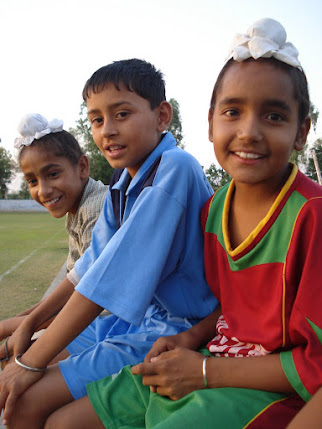
    At Phagwara station, we virtually dragged ourselves out of the train. The rush was overwhelming. It was a Saturday, and most Delhiites hop onto this particular train to head to the Golden Temple in Amritsar. But unlike our co-passengers, we got off at Phagwara. Traveling with a group of young footballers, we wanted to visit the pind (village) where football is next to religion.

    We had so far heard about the football cultures and traditions of Calcutta, Goa, and Kerala. But Punjab seemed different. As the bus weaved past vast agricultural lands on our way from Phagwara station to Rurka (about 15 km from Phagwara), we were thrilled. It was the end of April, yet the heat was tolerable.

    Rurka, a village in Tehsil Phillaur in Jalandhar, is entirely different. It is quiet, serene, and sleepy. Neighboring villages include Bundala, Kahna Dhesian, Dhinpur, Bir Bansian, and Pasla. In fact, Hans Raj Hans’ song “Pind Diyan Galliyan” comes alive as the bus moved deeper into Rurka Kalan, which lies on the Jandiala-Goraya road.

    A youth football academy in a village? That sounds fascinating. But before introducing the academy, let me tell you about Gurmangal Dass Soni. Soft-spoken and affable, Gurmangal is not a former footballer or a coach who boasts about past achievements. He is neither a referee nor an official who talks endlessly without action. Interestingly, he is an electronics engineer with a deep passion for football.

    In 1998, this young man, now in his late 30s, decided to create a football platform to help and promote the children of his village. He left a cushy engineering job in the US and dedicated himself full-time to football, selflessly. Another remarkable fact: Gurmangal does not draw a salary from this project, which has 14 paid staff members and an annual expense of Rs 24 lakh per year.

    He formed the Youth Football Club (YFC) in 1997, which soon became actively involved in promoting football at Rurka Kalan. With the support of local villagers and NRIs, he secured significant funding to run the project. Starting with around 15–20 footballers, Gurmangal began participating in tournaments—and even started winning them. Prize money from the tournaments was deposited in a bank, and he soon accumulated Rs 80,000. His family also supported him, contributing Rs 1 lakh per year. Villagers joined the effort, helping promote the game at the grassroots level.

    The YFC has produced six international players, from Anwar Ali (India and Dempo) to Surjit Singh Sandhu, Narinder Kumar Kaushal, Narinder Kumar Gill, Kulwant Singh, and Baljinder Singh. Today, the club boasts a Youth and Sports Complex, which houses a hostel for 24 players, a computer laboratory, a multi-purpose gymnasium, and a well-manicured ground. The club has also partnered with two schools, where students receive free education.

    Currently, the academy has 125 players across U-12, U-14, U-17, U-19, and senior club categories. All trainees are provided free boarding, lodging, kits, and education. The Sports Department covers the expenses of 15 students. The club has employed four coaches: Jatinder Sharma, Amarjit Dari (a former JCT player), Kulwant Bunty (a former international player), and Mandeep Kumar from the Sports Department.

  • RIP Kallu Mian

    RIP Kallu Mian

    Nahari

    I was sad to hear the death of Mohammed Rafiquddin, 60, legendary
    nahariwala, who was popularly known
    as Kallu Mian in Old Delhi.

    I had tried nahari at several pockets of Old Delhi including Bada Hindu Rao and Quraishnagar, but I was convinced none could beat the taste that’s available at Kallu’s.


    Nahari involves slow-cooked
    meat along with bone marrow and garnished to taste and was first developed
    during the Mughal Empire.

    I was introduced to the dish by some Walled City football fans. I was also told ‘a plate of hot and spicy nahari can give you relief from the
    biting Dilli ki Sardi’, which, in fact, turned out to be so true after those visits at Kallu’s. 

    It became a daily routine to walk down to the eatery at No. 80, Chattan Lal Mian behind Delite Cinema along with my elderly friends after covering the Vijayans and Okories at the Durand Cups, DCM Trophy’s and I-Leagues, held during the Capital’s coldest months.

    Kallu smoked bidis
    and, very occasionally cigarettes. After several visits, I found him to be very
    punctual as he would remove the lid from the huge copper degh (pot) at 5pm. The rush was inevitable because of the huge
    demand and the stock would be over in flat one hour.
    Most of his customers were from daily walks of life which
    also included officials from Old Delhi’s two famous football teams — City Club and
    Indian Nationals.

    In those eras, these clubs had fierce rivalries on the field
    just like East Bengal and Mohun Bagan in Calcutta, but one thing I couldn’t ask
    him if he was a City or Nationals fan. 

    Kya kar reea hai.
    Sahab logon ka jagah de
    (give space to these gentlemen),” Kallu shouted instructions
    in his old Delhi dialect.

    We were lucky to find a tiny space inside the shop. Sitting
    at arm’s length to the tandoor (oven)
    and next to the bread-maker, the forehead glistened with sweat, but the warmth
    was a protective cover to the freezing January winter.

    Kallu, who had a thin physique, guarded the oval-shaped degh, but he would only instruct his boys on how to scoop the thickest
    portion from the pot as it involved some kind of technique.

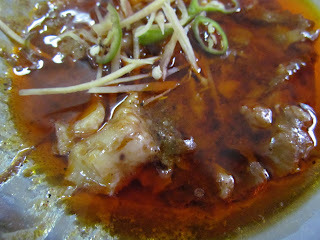
    The nahari arrived,
    glistening in a pool of oil. The roti
    was fresh off the tandoor and the
    extra plate of lime wedges, chopped chillies and slivered ginger completed the
    meal. The boneless mutton nahari was supple
    and succulent while the meat chunks already parted from the bones.

    Thanks to Kallu Mian and football, I was introduced to the mouth-watering dish.