Author: Mohammad Amin

  • Football and Purani Dilli

    Football and Purani Dilli


    It became a daily routine for me. I used to hire a rickshaw and roam around in old Delhi. I think it is the best way to feel the pulse of its historical existence. Rickshaw is the best transport available to pierce through its crowded serpentine alleys. Surrounded by crumbling walls and three surviving gates, purani Dilli is still very vibrant. It seemed so as the driver pedalled his rickshaw through the thick crowd.

    It is a city within a city. It may not be fascinating for the others but I had enjoyed every bit of my stay in the crowded Idgah Road and Sadar Bazar. So after settling down, I had experienced every bit of those rickshaw rides through its small galis. They are lined with 17th-century havelis whose once ornate facades are now defaced with rusted signs and sprouting satellite dishes. There is this uncanny habit in me. Whenever I am in a new city, I usually drag myself to look for football links.

    I was told that the Walled City had encourgaged and patronized the game to a great extent. I wondered if I would be able to reconnect football to Delhi since there was no Mohun Bagan-like tents. Or even a literature about its footballing history. Then someone had informed me that “if you want to search for the football passion, visit the Walled City”.
    Where is Mohun Bagan-like tents? Where is Maidan? I used to wonder if there were any football clubs. I had frowned then. But slowly I realized that despite the absence of club tents, football lived in every nook and corner of old Delhi.

    So for a football journalist, the visit was worth taking.

    In the halcyon days, driven by passion for the game, old Delhi traders and businessmen did not mind diverting their business profits into football, helping the emergence of well-known clubs like City Club, Shastri FC, Youngmen, Mughals, and Indian Nationals. While the clubs flourished, the game attracted the middle-class. Such was the clubs’ appeal that even common folks came forward with contributions as clubs like Indian Nationals or City Club became a part of their lives.

    Nationals, for instance, came into existence during an informal chat between some of the die-hard Delhi footballers of the pre-Independence era. There was an urge and interest to create a medium to express their intense love for football. So when YS Yadav, Sheikh Mohammad Shafiq, Mohammad Yasin and Hameed Khan sat under a tree at the historic Sunehri Masjid in old Delhi pre-1947, it had turned out to be a sunehra moment for Delhi football. Views were exchanged and Indian Nationals Football Club came into existence. The decision to form the team was later unanimously passed during a meeting held at the bylanes of historic Turkman Gate at House No. 2383, Kucha Mir Hashim, Chitli Qabar.

    Sadly, today these clubs are up against harsh reality. How to carry on their legacy without funds? I found a stark similarity between the old Delhi’s decay and the dwindling fortune of Walled City’s football culture which was once so dominant. Passion alone cannot take them forward. The clubs have ceased to enjoy patronage from the locals as well. And businessmen no longer support them as they used to. In fact, from 1996 till date, there has been a sharp decline in the interest among the locals.
  • Football introduced me to nahari

    Football introduced me to nahari


    The first time I had heard of nahari was in 1996 when I had come to Delhi for my new job. Before I left my home in Calcutta, I was told to stay close to my family friends at Idgah Road which is at the confluence of new and old Delhi. It was peak and strong winter. Yet I was enjoying every bit of it because Calcutta hardly has its winter seasons.

    Let me be very honest. I am happy to be a football journalist. You know why? Because it brought me close to the historical purani Dilli and its people. There are no pretensions. There are no egos. They are simple and down to earth who simply loved football and nahari.

    A visit to the Ambedkar Stadium for Durand Cups and DCM Trophy’s (in those days both these events used to be held in thick foggy winters) introduced me to some great football lovers who were from the Walled City. One of them, I was told if I had to beat the Capital’s cold, I should have a plate of hot, mirchi nahari with crispy tandoori roti.

    So after every match got over, we used to head straight for Kallu’s shop. Shop No. 80, Chattan Lal Mian, Jama Masjid. This is exactly the address where you would find a thick presence of nahari lovers. It was 5 pm. And the modest, small shop of Kallu was teeming with people. Men in skullcaps and pajamas are supping on nahari. I alongwith some club officials placed our order. I was told nahari gets over quickly in the space of 30 minutes. So, it’s better to rush.

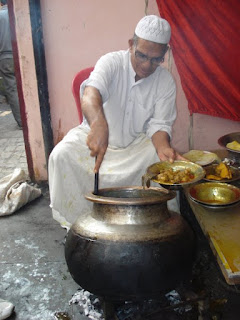
    Kallu in his thin physique sits on the main kursi (chair) from where he instructs his men to take orders. There is a huge deg and his staff were busy scooping the thickest portion (the best part) of nahari . It was glistening in a pool of oil. Kallu, in his typical purani Delhi dialect, shouts out instructions to his men. “Oye, kya kar reeya hai. Sahab logon ka jagah de de.” (Give space to these gentlemen). Minutes later we hop into the small space which also houses the tandoor (oven). Sitting near it meant that our foreheads glistened with sweat. Already felt the warmth even before the nahari arrived. The roti is fresh off the tandoor and the extra plate of lime wedges, chopped chillies, and slivered ginger completed the meal.

    The boneless mutton nahari is supple and succulent. The garlicky gravy, liberally spiced with javitri and dhaniya, is hearty. I was told the delicacy originated in the dastarkhwans of Old Delhi before it percolated down to other classes after the decline of the Mughal Empire. In my portion, the chunks of meat have already parted from the bones. As I reach the end, I used the last piece of roti to polish the plates!

    I am happy to be in Delhi!

  • With all the interest generated by EPL, why Indian football couldn’t spread beyond?

    With all the interest generated by EPL, why Indian football couldn’t spread beyond?

    In pre-independence India, while hockey players have invariably been Anglo-Indians, Muslims, Sikhs and tribals, Indian football was enthusiastically embraced only by the elite sections of society. The immortal IFA Shield winning Mohun Bagan team of 1911 had Hiralal Mukherjee, Bhuti Sukul, Sudhir Chatterjee, Manmohan Mukherjee, Rajen Sengupta, Nilmadhav Bhattacharya, Kanu Roy, Habul Sarkar, Abhilash Ghosh, Bijoydas Bhaduri, Shibdas Bhaduri who belonged to the bhadralok (gentleman) community in the pre-independence India.

    The failure of hockey is a sign of the inability of the nation to accommodate its minorities. But it remains a mystery as to why football has also failed at the national level. As in the case of hockey, the game flourished in the immediate aftermath of independence, with tournaments like IFA Shield, Rovers Cup and Durand Cup attracted large crowds and featured clubs from all over the country. Many of these teams — Andhra Pradesh Police, Punjab Police, BSF to the recent Kerala Police — were great teams that fielded players of the highest calibre.

    However, the fact that most of these teams were government-sponsored and not locally supported clubs suggests that the game was not organic to the areas these clubs were based in. When state patronage began to wane, these teams disintegrated rapidly. Another reason to this theory could be the localization of football in just two states — Bengal and Goa.

    With all the interest generated by EPL and Champions League, why football couldn’t spread beyond this limited geography, remains a big mystery. The very manner by which football became a popular sport in these states proved to be an impediment for further growth. Interestingly, in the case of Bengal, football became a tool which was used to construct a modern Bengali identity in the wake of the large influx of immigrants from East Pakistan now (Bangladesh) after Partition in 1947.

    Bengalis devoted their time and energy more in a East Bengal and Mohun Bagan rivalry than just dedicating towards a greater programme to find out talents and popularise the game beyond Bengal. All this meant that football was totally internal to the cultural system and couldn’t capture a significant portion of the market in the new economy. Globalization has caused its appeal to diminish even in Calcutta.

    In Goa too, football was used to construct ethnic identity. Once again, the game remained restricted to a small region. Why football has failed to spread wholeheartedly in India? How is it that a sport that elicits so much passion in one Indian state fails to do so in another? To be honest, there is little literature on Indian football and also how different ethnic groups impact on each other. In fact, the mystery surrounding the collapse of football could be better elucidated if we possessed a theoretical framework for analysing such phenomena.

  • Bob, we also had Rahim

    Bob, we also had Rahim

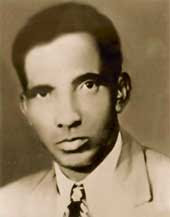
    I had read about Syed Abdul Rahim when I was 10. From that precocious age till now, his name continue to stirr a lot of interest among the aficionados. With his small frame, Rahim was and is by far the most successful Indian coach.

    We talk about Bob Houghton’s angrezi style. Rahim was simply desi. Yet he was hugely successful and churned out more glories for Indian football than any other coaches. During my conversations with his son SS Hakim and his famous students Peter Thangaraj (who passed away last year), Chuni Goswami, PK Banerjee, Balaram, Yusuf Khan, Syed Nayeemuddin and others, one thing was clear to me. Unlike Bob, he was modest and down to earth and an Indian who wanted to give his best shot.

    Not many would know, Rahim used to write couplets framed around football techniques. He was a qualified physical trainer and a referee. Hence, Indian team didn’t require a physio during his era. His teachings were simple and to the point. No wonder he had produced a genre of footballers who became living legends.

    A creditable performance by the Indian team at the London Olympics in 1948 and at the first Asian Games raised hopes among football fans that this country was on the path to fame and glory in this sport. But their hopes were dashed at the Helsinki Olympics after a 10-1 drubbing at the hands of Yugoslavia. That was when Rahim decided to beat the European teams at their own game.

    He carefully studied the methods of the Europeans and modified these to suit Indian conditions and Indian players. Besides, Rahim knew exactly where the weak points lay in the national side and managed to mitigate these and build a formidable team. He put his boys to the test on a tour of USSR in 1955 and then again during a home series in 1956 before the team took part in the 1956 Olympics in Melbourne and came fourth. Till now that has been India’s best show in the Olympics. Neville D’Souza was the top scorer in the tournament.

    Rahim had an excellent understanding of the requirements of the game and the material he had in his hands by way of players and their skills. Moreover he also had the advantage of having some exceptionally skilled players in the side in those days. Many of them were from Hyderabad and he was therefore familiar with their abilities.

    He was able to establish a good rapport with his players and they knew exactly what he wanted of them. The players in turn had tremendous respect for Rahim and did their job with great zeal. The Hyderabad Police team in those days was one of the best in the country and had an enviable record in domestic tournaments. With talent available in plenty in centres such as Hyderabad, Bengal, Bombay (sorry Raj Thackeray, I like to use the original) and Madras, Indian football seemed to be on firm ground and India seemed to be proceeding along the right lines. But then came the slide, which left many fans disheartened.

    For the next 10 years, till Rahim died on June 11, 1963, India were one of the strongest teams in Asia. Single handedly, he raised a highly talented side that included legends like Chuni, PK, Tulsidas Balaram, Yousuf Khan, Jarnail Singh, Arun Ghosh, Thangaraj, Ram Bahadur, Kempiah, SK Azizuddin, Zaufiqar, Prasanta Sinha, Franco and many others.

    The country has now slipped down the ladder and even at the Asian level, the national squad is considered a mediocre team. Indian football followers now feel saddened by this downward trend in the standard of football in the country. Perhaps what India now needs is another coach of the calibre of Rahim.

  • Playing football on Iraq’s minefield


    I guess the Indian football federation or their bosses at the Asian Football Confederation (AFC) should be aware of Iraq’s current situation. You don’t have to be an elderly statesman to know what is Iraq today. You sit in Geneva or at Kuala Lumpur or even in Delhi, everybody is aware of Iraq’s current political turmoil.

    But I would like to know if AIFF or any of the AFC officials have recently been to the strife-torn nation. It’s not an exotic hot sea beach of Mauritius or an expedition to Masai Mara. Iraq is all about a terror-filled nation. Killings, bombings continue to hit hard. I guess, the football officials would definitely skip even a sponsored tour to Iraq. Then why send some innoncent young footballers to Iraq particularly after the countinuous upsurge in violence in recent years. Why did they shift India’s Group C matches to Iraq? Is it all about football promotion or ensuring a ‘genuine’ vote for the next AFC elections.

    Is it a sheer lack of vision or a deliberate attempt to promote football in a country where gun-totting US security forces are a common sight? And AFC talks about playing football on a minefield. Post Saddam Hussein, suicide bombers and explosions have become too common. Iraq has become the next Aghanistan and Pakistan. Maybe, even a bit more scary and volatile. Definitely you cannot put these teams including India on the gallows because you never know which way the suicide bombers will chase you. Be it Mosul, Baghdad or even Arbil (where the AFC U-19 Championship’s Group C matches will be played) violence and killings have become a regular sight in this West Asian nation.

    Besides last Sunday’s twin suicide bombings in Baghdad, which left at least 155 people dead, are playing on the players’ minds. Arbil, the venue of the AFC event, lies 80km east of Mosul in north Iraq and it is the capital of the Kurdistan Autonomous Region and Kurdistan Regional Government. The attacks were the deadliest in Iraq in two years. No wonder, the young Indian footballers are scared.

    The very fact of playing their qualifying matches in Iraq has terrified the Indian team, who are caught in a web of fear and anxiety. India have been drawn with Afghanistan, Iraq, Oman, Kuwait and Saudi Arabia in AFC U-19 qualifiers.
    The Indian players, who are currently on a tour to Dubai, are terrified. They just don’t want to travel to Iraq. It is quite risky. But it’s difficult to convince the AIFF and AFC mandarins who are just too excited to promote the game in Iraq.

  • Has football administrators become cheap?

    It didn’t surprise anyone. Not even me. That Mr Praful Patel won’t be announcing the dates for the already pending interviews of those who had already applied for secretary and CEO posts. It’s been three months now. Once again, Mr Alberto Colaco has been given an extension till December. While some say it has been deliberately done because of political pressure, others still hope that the dates will come out soon. Whatever the reasons may be, it was not what we all had waited to beat Delhi’s evening traffic and reach on time at the IRDA Complex.
    It seems that the media and the entire football fraternity has been fooled by AIFF mandarins. Why the AIFF’s Executive Committee keep pushing the interview dates, I still fail to understand. Well, I guess it is all about the murky politics that is being played inside the corner rooms of Football House.
    Just before the AGM and Ex Co meeting on Oct 20, important officials were given cushy assignments like foreign tours. While others have been asked to wait. It has been designed to perfection. Nothing can beat this game. Give any member a foreign tour. Make them managers of the Indian team or Delegation Head (???), they would be happy to serve you.
    The power, the importance of being AIFF secretary definitely holds a lot of importance. So it was not surprising to find that Mr Colaco (who I knew as an easy going, soft spoken and an affable person when I met him first in 1998 in Goa when he was GFA secretary) will pull all the strings just to retain the post. But then Mr Colaco why don’t you leave the Football House gracefully rather than hang around with people around want you to bid goodbye. Someone should tell him and make him understand that world is too small a place and AIFF is only a small portion of it. Has anyone told him that he cannot hold on to two different posts?
    Now that he has been elected as SAFF secretary, it would be better (ethically) if he vacates the AIFF secretary’s seat rather than take favours from the spineless Executive Committee members most of whom are already senior citizens turned Machiavelli. So just like a pilgrimage tour, these senior citizens (Ex Co members) wait for their turn. It may be not be a Haj or a visit to the Kashi and Badrinath. But definitely more colourful tours where you get to see the unseen world.
    Has football administrators become cheap?

  • Why a cricketer should apply for football secretaryship?

    Why a cricketer should apply for football secretaryship?


    A sudden spell of rain and a soggy afternoon didn’t dampen my spirit from attending this one particular media conference at Mr Praful Patel’s office at Ministry of Civil Aviation. I virtually rushed upstairs to catch the ‘surprise package’ which the AIFF emergency committee members were waiting to uncork in the run up to pick the next general secretary.

    But I fail to understand why there has to be so much drama to pick the best candidate for the interview? There are couple of candidates who don’t have any footballing background yet they made the cut. I have even heard of a former cricketer who wants to occupy the hot seat. Has our football set-up been reduced to kind of a joke?

    After AIFF became a full-fledged organization in 1948, it had ‘veteran’ secretaries who were often blind to realities of modern football.

    Ever since I had started following football in the late 70s, I have heard of Mr Ashok Ghosh (I remember watching him on the TV during the inauguration of Nehru Cup in 1982) and K Ziauddin. Just as a nation we rely on our veteran leaders, the Federation also picked on secretaries who were in their ‘retirement’ age.

    After Ghosh, I came across three more secretaries (PP Lakshmanan, KN Mour) and the current incumbent Mr Alberto Colaco. Otherwise, Indian football wouldn’t have a fall after the 1970 Asian Games bronze. We lost our Asian supremacy. Today, we are struggling to keep pace with south Asian nations. We have to understand why we are falling back. Why we had to wait for 24 years to secure Asian Cup berth? Why our youth development programme is mired in over-age controversies?

    So why were shuddering to recruit someone who is young, dynamic and have a vision for Indian football. Would it be detrimental to the football development if AIFF goes in for a young secretary? I don’t think so. And I’m sure most would agree with me that by having someone young, Indian football definitely won’t stumble. AIFF can only have some fresh ideas and a motivation to initiate productive work.

    There are officials who want to politicize the entire process. Some even want to ‘put’ a proxy candidate. It is quite embarrassing for Indian football.

  • Bob where is the reserve bench?

    Bob where is the reserve bench?


    One wonders if Bob Houghton is really serious about Indian football’s development. Three years at the helm, the Englishman has once again reposed faith on his ‘old bunch’. The recent probables announced by the All India Football Federation (AIFF) doesn’t seem to convince us about his seriousness. The same old faces have been chosen. Bob had since been talking about finding some new talent. He had told us several times in the past that only after watching I-Leagues and Fed Cups he would be able to scan the latest talent in Indian football. But those seemed to be just hollow talks as the Englishman had reposed faith on the same group.
    Is there anything which is stopping the Indian coach from giving opportunities to some of the players who did well in I-League? Is there any agenda against these players who simply struggle to get a call for the national camp?
    We still don’t know. But there has been rumour about a possible coterie inside the Indian team and Bob is under its influence. Mohammad Rafi the left-winger who probably scored more goals for his side than any of his strikers still finds himself out of favour. Rafi is tall and revels in an attacking blend of football. Then has Bob thought about S Venkatesh, who has impressed with his all-round performance for Pune FC in the I-League II.
    Mohun Bagan left-back Nallappan Mohanraj and JCT central midfielder Jagpreet Singh have been picked, who have been to camps in the past. But where are the rest? Is Bob the only person who is in the selection panel?
    Well, we don’t know. We are still groping in the dark. We aren’t sure if India would be able to break the jinx at 2011 Asian Cup. Let’s face the fact that we are still unable to organise our team. Bob’s high-profile Goal Project 2011 has already bit the dust with the Federation saying it is “impossible” to carry out a mega project. So come June, the Indian team will assemble in Delhi for another grinding session and, not so surprising, with the same old faces.

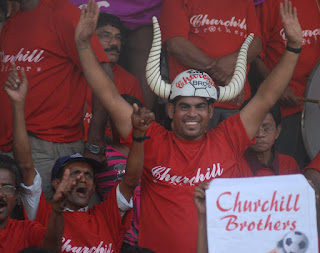
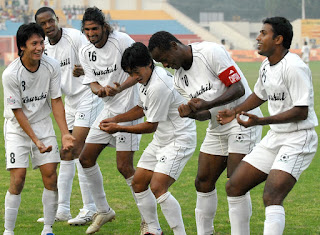
  • Churchill deserved to win I-League

    Churchill deserved to win I-League


    Watching intently the Mohun Bagan-Mahindra United match at Ambedkar Stadium on a sudorific Thursday, I was figuring out why Bagan shouldn’t win this year’s I-League. A huge posse of mediamen along with club officials took the flight out of Kolkata probably hoping to witness another Bagan’s triumph and occupied the vantage positions in the crammed media box much before the scheduled time. But before everybody including the teams could settle down the babumoshais were calling up their sources in distant Margao in Goa where Churchill Brothers were up against a feeble Mohammedan Sporting.

    A journalist sitting next to me, whispered, “Churchill had scored.” A couple of minutes later, the Goans hammered yet another. A minute later, I could read their body language. It conveyed a crude message. Bagan’s boat won’t cruise further. Even if they had won against Mahindra, who however dumped their famed rivals 2-1, Churchill’s outright win had settled the issue on points. Bagan will have to wait another season. For the record, a Goan team has prevailed over a Kolkata club for the third successive year.

    Going into the final round I-League matches, there were lot of permutations and combinations. What if Mohammedan beat Churchill in Goa? What if Bagan win against Mahindra? But in the end, none of these calculations proved correct as winners were decided by goals rather than calculations and both Churchill and Mahindra went back home with full points.

    In my previous article, I had mentioned about a certain arrogance in Churchill (I mean the team). Surprisingly, it stems from their boss, Alemao, a confident and ambitious general who in the past had vowed to make his family football team the India champions. Last year, they had almost finished winners. But Churchill finished on same number of points with Dempo, who pipped their Goan rival on a better goal difference.

    On Thursday, the 6-2 demolition of Mohammedan convinced Churchill’s superior dominance both in the match as well as in the entire event. If Alemao is their source of inspiration, Odafa Okolie charted out his team’s success in the middle with his 26-goal bursts in 22 matches. A roughly 1.5 goal per match. An incredible achievement. The figure also explained how the tall and temperamental Odafa single-handedly annihilated the rival defence. Arrogance, brute power and a nose for goals combined to make Odafa the most famous striker after Chima Okorie and Ramirez Barretto, who now seems to have been completely overshadowed by the Nigerian.

  • Churchill lives on Alemao’s passion

    Churchill lives on Alemao’s passion


    From Margao, it took barely 30 minutes to reach Verca. “Where is Churchill’s house” ask any commoner on the way and you would be directed straight to strongman Alemao Churchill’s house. It is one of those typical Goanese house located deep inside a sleepy village which remained calm and composed even on a Sunday morning.
    The moment I walked in, I saw a blackboard right infront of the entrance. It was the “appointment board” of Alemao (Churchill Brothers’ leadman). Being a minister in the Goa Government, he seems to be a busy man, I thought. Besides his footballing passion, he is also supposed to take care of his constituency.
    After waiting for almost an hour alongwith other visitors (most of them had come to narrate their problems), the big, burly frame of Alemao finally trooped out of his rest room. Wearing his trademark spotless full-sleeve shirt and trouser, he said: “Sorry, I am late. Come, please come inside.” He directed me to his modest one-room office at his residence where he listens to each and every problem of his ‘people’– from a cancer patient who has been denied an appointment in a Mumbai hospital to a youth looking for an employment.

    Yet, during that two-hour chat I had noticed how well Alemao had balanced his role –footbal administrator-cum-minister. So it was not surprising that you listened to “Churchill Brothers” more than anything else from him. It was on his lips right through as he believes his club isn’t an ordinary one. He wanted to dominate Indian football. This season, now that his team is firmly placed in I-League, Alemao should be all prepared to host a gala get-together at Verca.
    Being at the top of leaderboard with 42 points, his club can only think of completing a formality, untill and unless they commit a harakiri. With Sporting Clube de Goa and Mohun Bagan sniffing down their shoulder, Churchill should play their last two matches with a composed mind. At this final hurdle, a slip in between is bound to haunt them for long. Like last year, when they missed the title just on goal-difference to Dempo.
    Interestingly, this season their hitman and skipper Odafe Okolie (24 goals in his kitty) have ensured that even if they finish equal on points with their nearest teams, they still would have a decent goal-difference to sail them through.

    There is this invincibility which makes Churchill a treat to watch. Alemao had always “imported good players and coaches” — Karim Bencharifa and Odafe were the latest imports in Churchill bandwagon. In fact, Alemao will go deep to find out decent combinations for his team. I feel, he is a better manager than any of those who are running club football in India.

    Over the last couple of years, Alemao has successfully proved that East Bengal or Mohun Bagan are not unbeatable. During the transfer market, while the rest of the clubs would look for bigger names, Alemao would inevitably hire low-profile TFA cadets. Arindam Bhattacharya, Gourmangi Singh, Naoba Singh are some of his young players who have blossomed in his team. It is this idea of nurturing young talents which is now doing wonders for a team which lives on Alemao’s passion.