Blog

  • Lemon juice, Chhetri and Amirican futbal

    Lemon juice, Chhetri and Amirican futbal

    Friday must have been astonishingly a great day for Sunil Chhetri. For us in India, I am sure, we will be keeping a tab on Kansas City Wizards in the coming days. Just like we did for Baichung Bhutia almost a decade back when he had turned out for Bury FC in England.

    A day after this significant move by Chhetri to MLS, here comes a stunner from Delhi where Chhetri was born, brought up and made his debut with City Club. I took a stroll down the Bahadur Shah Zafar Marg and landed up at the Ambedkar Stadium where two local teams (New Delhi Heroes and Simla Youngs) were engaged in a I-League second division match. I thought the local association (DSA) would be all geared-up to cash in on the good news.

    Let me recount the step by step account of what transpired on the Saturday afternoon at the Ambedkar Stadium, a day after Chhetri was officially presented by KCW in MLS.

    On the dais, I found some DSA and some club officials caught up with some mundane discussions. One of them requested me to pull a chair and take a seat. Firmly ensconced, I began to observe them and their football talk. In the meanwhile, some more officials huddled near the VIP stand. Their eyes were fixed on the match. Down the dusty and uncleaned stairs, I noticed a top DSA official chatting with a laptop-wielded journalist.

    After the discussion got over, he lifted his ageing body and he took a slow walk towards the VIP box. Then he shook hands with me and asked if I would require some refreshments. I said: “A lemon juice would quench my thirst.” Then he sat in the middle of his trusted comrades and started to scribble on a piece of paper. I took a chance and asked him what he was writing. “Nothing,” he smiled. The usual pen and paper work so ideally suited for these DSA officials. I wondered, if DSA was planning to do something for Chhetri’s achievement.

    Enjoying the action on the field, none of these officials however had Chhetri on their mind. I don’t know whether it was their pretension. Or if they hadn’t browsed through the morning newspaper. Maybe, they are more keen on publishing their own DSA-centric events. So I guess they must have ignored the Delhi boy’s tie-up with Kansas City Wizards in the MLS.

    Do they know David Beckham also play in MLS? Hmmm. Wait. Wait. Next time, I plan to throw a question at them: What does MLS stands for? I’m sure they would say “Amirican football.” But I promise, I won’t laugh. No matter how much you make an effort to teach them, these officials want to stay in the unknowing world.

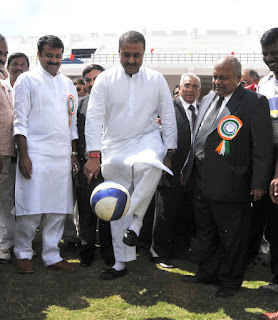
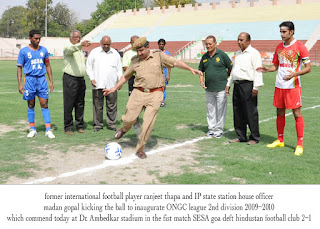
    Let me recount another hilarious incident. The I-League second division got inaugurated by a pot-bellied Delhi cop who tried his best to show his footballing skill by whacking the ball. You can expect such drab and dull inauguration with DSA. Still you cannot blame them because apparently it all happened in the presence of a newly appointed I-League CEO and a couple of other All India Football Federation (AIFF) officials. They too sipped the lemony juice alongwith me. Even munched some biscuits with good quality tea. Yet they lacked the qualitative idea on the promotion of Delhi soccer. They could have cash in on Chhetri’s joining a MLS team with congratulatory message spread all over the ground with his pictures (I hope they have them).

    Alas, there were only lemon juice, tea and biscuits. Even Chhetri would laugh if he were told about this story.
  • Indian Football vs Indian Hockey

    Indian Football vs Indian Hockey


    Twice I had to dump the idea of going to the refurbished National Stadium to watch a World Cup. I was a tad disappointed. Not because I couldn’t watch a single World Cup game at home but Indian team’s early ouster was highly discouraging. I wanted to watch Jose Brasa-trained Indian team. I wanted to follow another national team coached by a foreigner. Post World Cup, the media has done lot of incisive and indepth reasoning behind Indian team’s failure in the World Cup. But apart from the technical aspect, none of the writers wrote about the ground realities.

    Look at Australia. Just a couple of years back we shown the door to Aussie Ric Charlesworth. Back at the helm as Australia’s chief coach, this man has produced some outstanding result. Here we made a mistake. We should have allowed the expert (Ric) to do his duty as Indian hockey’s chief advisor. He would have done a decent job, I am sure. Here the Indian hockey administrators made a huge mistake.

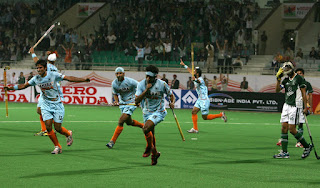
    Lot of people ask me the difference between Indian hockey and Indian football. Well, I tell them that Indian football has a structure in place unlike hockey. Soccer is played in schools, colleges and universities. In the gullies, in parks. There are so many national age-group football events organised by AIFF or even by state associations and academies. Many would still argue that in hockey you need astro-turfs while it is easy to kick a football on any pitch. But then given the presence of quite a number of astro-turfs, how many national events have been organised by our hockey federation. I remember, I saw a tattered astro-turf the last time I had visited SAI Centre in Calcutta.

    Soccer has flourished in India because there is a definite plan. But above all, every affiliated unit is answerable to FIFA who has a strict guideline pertaining to soccer promotion. It doesn’t happen with FIH. In India, we have bungled everything. From resources to grassroot programmes and even our national championships. Besides, the faction war within the hockey administration and a myopic vision were enough to strangle India’s national sport.

    Now contrast this with football. Though Indian football team hasn’t played in a single World Cup (I’m not going into the comparison with hockey and even with cricket World Cups because the qualification process in football is quite tough) even then I would say the game has got a well set-up plan. I am not sure if Brasa would be continued after Indian team’s eighth position finish in World Cup. But if the Spaniard is asked to go, then Indian hockey would again go down the drain. Look at Indian football. We have reposed faith on Bob Houghton ever since he has joined in 2006. That’s quite a good idea if you consider the long-term plan. The U-16 and U-19 teams are groomed by yet another revered coach Colin Toal. Houghton has been able to create a supply line which I guess augurs well for the future senior teams.

  • Crocodile Tears

    Crocodile Tears


    The previous post was flooded with lot of queries and reactions from the football fraternity. But few understood the message. Some thought I was criticising the AIFF. Well, it was definitely not a tirade against AIFF deal or a corporate tie-up. I only highlighted the corruption inside Football House. It wasn’t any figment of an imagination. So those who still couldn’t read the actual message, I request them to browse through it once again.

    Shouldn’t we have some clarity on Indian football officials? There are plenty of unanswered questions which needs to be answered. We need to know who are the ‘brains’ behind Indian football’s development? Why the ‘outgoing’ secretary Alberto Colaco is still around despite resigning last June? Some say it is his ‘crocodile tears’ which has helped him win those AIFF members who wanted his removal after former president Priya Ranjan Dasmunshi went into coma.

    Ahhh. Crocodile Tears! In Hindi, we say magarmach ke aansoo. When I grew up , my mom had nicely explained me the right usage of the phrase. So here we are in the dubious world of Indian football federation where the dribble for power overtakes Indian football’s development plans.

    The Goan, who was hated by couple of vice-presidents and members till a year back, now successfully has wooed them. Sending ‘rebel members’ with the Indian teams as managers on outstation tours is seen as a perfect move to keep them quiet. You oblige them and then staple their mouth. So it was nothing surprising to see him continue as secretary without any protests. I was told by one state asssociation secretary that he always wanted to tour with the Indian team to a foreign country. Poor guy, he was never in the good books of the AIFF secretary because he isn’t that ‘influential’ unlike others.

    So Mr Colaco, we haven’t heard of the appointment of your new successor. What happened to the interviews which were supposed to take place last September? The entire football fraternity want an answer. If it is a democratic process, let not the candidates sulk and deny them a chance to appear for the interview which was advertised by your office in July last year. I was told that the earlier process has been scrapped and the burly Goan had been asked to ‘train’ a youngster for the coveted post. Interesting, isn’t it?

    Last month, his Goan pal Joaquim Alemao was promoted as vice-president after spending a year as an ordinary executive committee member in AIFF. Wait. He uncorked one more surprise. The ‘outgoing’ secretary allegedly ‘planted’ Daman & Diu secretary Franco Miranda to the executive committee. For your information, Daman & Diu doesn’t participate in AIFF tournaments and they were sanctioned for not following the AIFF norms. So why did Mr Colaco gave him an entry? Simple. Some say he purposely did it because he wanted to stop his Goan rival Savio Messias from becoming an AIFF member.

    While some officials have turned out shadow ‘agents’, here the secretary himself has been using his office to snub his rivals. We have a request, please don’t tarnish football and AIFF with your dirty politics. You guys can settle your old score outside the Football House, probably, over a mug of beer on Goa’s golden beaches.

  • Who is this ‘agent’ inside AIFF?

    Who is this ‘agent’ inside AIFF?


    Last year, I got an anonymous mail from someone who wanted to expose a big racket involving Indian football and that too right inside its headquarter at Football House. Almost a year later, the rumour have resurfaced again following the Panasonic deal with AIFF. There are strong rumours that one of the top AIFF officials has operated as a ‘shadow’ agent on behalf of Panasonic and in the process made good money. Last year, when I broke the news about this ‘shadow’ agent to AIFF’s all-powerful and power-centric secretary Alberto Colaco, he looked the other way.

    How can a person who is engaged in bringing money to football federation, can actually engage in personal business ventures? Why they use their AIFF profile to build network for their future business expansion? Colaco, once again, looked the other way and smartly evaded the question. Actually, he didn’t want to answer because he himself has been partly responsible due to his faulty recruitment policies. No matter how much you make him understand, Colaco gives a damn.

    In 2006, Colaco had appointed Satyajit Sadanandan. Football was not his qualification. He is an IIM Grad. Still he made it to the Football House because Colaco was hopeful that he would be an asset for Indian football as he will create marketing strategy for Indian football which was looking for financial support. After two years, Satyajit was promoting football but for his own company.

    Colaco didn’t specify why he had recruited Satyajit, who didn’t have any knowledge about Indian soccer. Be its history or about the tournaments (surprisingly, he was made Director, Projects). Within two years, Satyajit ditched the federation and got engaged with his own business venture — sports marketing company based somewhere in Bangalore. Sounds interesting, isn’t it?

    It was alleged that he even got hold of an influential FIFA official who was then looking after the south-Asian programme which included India as well. After the FIFA official quit his post, he found an ally in Satyajit, who was his India partner in a company which specialised in football consultancy. Some says that Satyajit and this AIFF official (‘shadow’ agent) is well connected and they work on a profil-sharing basis.

    But who is this AIFF official who took a huge cut as the ‘shadow’ agent in the Rs 5 crore Panasonic deal? Why he gets this sort of leverage in AIFF? Is it morally correct to use AIFF contacts to reap personal benefits?

  • RTI and Indian football

    RTI and Indian football


    S Ravindra Bhat is not a sportsperson. Neither he is a sports administrator. But he has done something praiseworthy which not even the government couldn’t do in all these years. Well, Mr Bhat is a judge and is credited with a historical ruling which has considerably expanded the scope of the Right to Information (RTI) Act on sports associations.

    Last week, the Delhi Hight Court has asked the Indian Olympic Association (IOA) and the Commonwealth Games Organising Commitee (OC) to shed opacity and set up an office to disseminate information and depute a public information officer (PIO).
    They were brought under the ambit of the transparency Act which I’m sure is expected to open the floodgates of pointed RTI queries directed against these sports bodies, seeking information about their management, grants and administration. The judgment will have an impact in injecting an element of accountability not just in IOA and OC, but in all the sports federations.

    Meanwhile, our Sports Minister MS Gill is trying to make Indian sports clean. I’m not sure how far will he be able to succeed. But atleast he has forced federations to function in a transparent, dignified manner. Though the federations are autonomous bodies and most of them function in archaic, feudal manner yet the minister wants to them to fall in line with the “democratic principles of the country”.

    That’s great news. But what about our football association?. Since this blog exclusively focuses on Indian football, I would be ask Mr Gill if he can bring about a change in All India Football Federation (AIFF).

    In June last year, AIFF secretary general Alberto Colaco resigned from the post. The AIFF executive committee decided to hold interviews to select the candidate who would replace Colaco. Even the vacancy was advertised on AIFF’s web portal. Lot of candidates applied for the post. But only the “right candidates” were shortlisted for the interview. They even received their call letters. But surprisingly the interview never took place. Why? Well, that’s what we have been trying to figure it out.

    It was learnt that Colaco, apparently, in his last ditch effort, has been trying to manipulate the big bosses at AFC and FIFA and use their influence. In one of the tours to Zurich alongwith the Sports Minister, the outgoing secretary had asked an important FIFA member to influence Gill. Now we know why AIFF hasn’t yet finalized the interview date and Colaco was happily given an extension by the executive committee which otherwise is happy to bow to the Goan.

    AIFF’s secretary post is a paid one. But it assumes a lot of significance. Anybody would love to hold it for long. But Mr Gill’s call to democratize system has taken a beating. Once the vacancy is out and the candidates have been selected, why the AIFF has dillydallied on the interview date.

    Indian Hockey Federation (IHF) was dismissed by IOA to bring in a fair, clean, new management. As Mr Gill said: “We can’t have a system where “there is no appeal, no daleel, no vakil”. Why the sports ministry, who has dolled a huge chunk of public funds to the federation, should not pull them up?

  • Negative publicity is good for Indian football!

    Negative publicity is good for Indian football!


    Thanks to the reports and TV visuals of the alleged molestation of an air-hostess by Okolie Odafe and two other footballers, there is a buzz around Indian football. From Tuesday (Jan 5) till Wed (Jan 6), TV channels and newspapers have indulged themselves in scooping gossipy stories around Churchill Brothers’ three footballers who were arrested at Mumbai airport on their way to Kolkata for the I-League match.

    Nobody knows the truth. Odafe says he is innocent and was seen requesting the TV anchor to get his camera from Goa which the Nigerian claims has visuals of the entire incident. But first and foremost, was there any need to highlight the entire incident? Are these footballers did what former Haryana DIG SP Rathore did years ago? Are we not exaggerating the entire episode?

    The truth is not yet out. So why put these footballers on the gallows. Particularly, Arindam Bhattacharya who seems to be so promising. I’m sure it would have an adverse effect on his career. Last month in Dhaka, Arindam single-handedly won the SAFF Cup for India in the final when he saved three penalties in the tie-breaker against Maldives. Did anybody notice his agility under the Indian goal? Did the media bother to interview him? Did that TV anchor, who I’m sure may not care about Indian football and footballers, profile this young goalkeeper? He didn’t. Neither the newspapers wrote any parody on the Indian footballers.

    After all, gossips keep us happy. I’m sure everybody derive a strange pleasure from gossips. And media blows it up. It is some kind of a masala for them. Why don’t we keep these incidents a little low?

    Just two days back in Guwahati, a young and upstart football team fought bravely before going down in the Fed Cup final against East Bengal. But nobody took any interest in Lajong or in East Bengal. Even during the Nehru Cup final last year, journos were more interested in Salman Khan, who was present at Ambedkar Stadium as Indian football’s brand ambassador, and didn’t bother about an Indian victory.

    Let’s accept it. We are pretenders. We don’t care about any achievement. We stay awake for gossipy, raunchy news items. If that is the case, then why the media stayed quiet during all these years even after a young girl had committed suicide in Panchkula in 1993? Why are they now gunning for Rathore who should have been put behind bars long time back?

    As far as these footballers are concerned, it is too early to comment on their unruly behaviour. No doubt, it was an unfortunate incident which may have tarnished even the image of the club (the sponsors have already decided to pull out). But it was too early to blow things out of proportion.

    Let’s wait, till the verdict is out.

  • Kaka and Kabab

    Kaka and Kabab


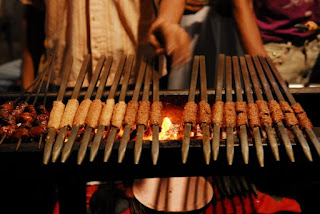
    It was a cold, cold night in Delhi. The mercury touched an all time low in December. We, a handful of journalist friends, thought it would be wise to head towards Jama Masjid. The idea was to grab some quick hot kebabs knowing that Old Delhi is the only place on the earth which would stay awake even after midnight. That’s the best part of purani Dilli. If you are hungry and looking for some food in the night then the Walled City is a heaven for you.

    Roasted chicken, fried chicken. Rumali, khameeri roti. Shami kabab, boti kabab. Your mouth starts watering understanding that working late hours at office and then frowning over the routine canteen stuff can take you to only one destination for a change of your taste buds. And then a ride through the deserted Bahadur Shah Zafar Marg in a spotless maroon Ambadassador car ignoring the Hondas, Ascents, Corollas.

    It was all so otherworldly, like being in a hill resort. The city noise had faded to a distant hum. The air had grown thinner. And Jama Masjid was just an arm-length’s away.

    As we parked the car adjacent to Gate No. 1 of the historic monument, Kaleem, a young guy in his early 20s, rushed towards us. “Sahab kya chahiye?” A bearded old man in his 70s (probably the owner) was wearing a spotless kurta, pyjama and shouting instructions in his chaste Dilli Chey (six) accent. He seemed to be a devout Muslim. He was wearing a skull cap wrapped with a muffler and sat near a angithi (charcoal fire). It was severe cold and the chilly wind was piercing through the thick woollen cover. “Kabab aur rumali roti le ao,” One of our friends got a little excited at the prospect grabbing hot kababs and roti. Kaleem was happy. So was his owner. After all, you don’t often get such wonderful customers late in this cold December night. Good business, yeh.

    As my mind traversed through the space (old Delhi), Kaka, the ace Brazilian footballer popped up! That too in front of the stony Jama Masjid looking lonely amid the concrete of Delhi’s unplanned modern architecture.

    Well, well, well. Wait. Let me tell you how the Brazilian accompanied us to the roadside kabab stall. My friend, who is a great football follower and owner of that swanky ambassador and, suddenly paused. He didn’t pick up that last piece of chicken from the plate. He glanced upon on this piece of newspaper (which served as a tissue paper for the kababwala) and which Kaleem had given us to clean our hands. “Hey see, Kaka is here. And see who has written this write-up,” his face flashed like a thousand-watt neon lamps. He probably didn’t expect to see his byline on the bylane of Jama Masjid. He broke into a huge laughter. I too joined him. The world is too small a place. I wondered.

    We were happy. For both kabab and Kaka. Though Kaleem didn’t understand the significance of our conversation. For him we were just kabab lovers who ate and did ‘wah wah’. But for both of us (we had covered the Vijayans, Pappachans, Krishanus & Bhutias with passion over years), the subject was interesting. Kaka and kabab.

  • Pseudo Pride: How Bengal Lost Its Football Soul

    Pseudo Pride: How Bengal Lost Its Football Soul

    Is it unfair to use the word pseudo for Bengalis? Friends in Calcutta and elsewhere might urge me to choose a softer expression, calling it too harsh. 

    Yet, the more I reflect on what I see around me, the harder it becomes to avoid the term. 

    When I watch Bengal’s Leftist leaders, the word seems unavoidable. When I watched Bengali cinema—before I stopped altogether, as producers turned into copycats churning out action-heavy remakes of Bollywood and Hollywood films—I became convinced that originality had given way to imitation.

    The babumoshai (gentleman) appears to have turned into a pretender.

    The same sense of loss is evident in football. 

    Once it was Bengal’s sera khela—its favourite sport. 

    But today, it no longer seems so. Just as the simple joy of buying fresh fish or shrimp from the macher bazar (fish market) has faded, football too has lost its emotional grip on the Bong psyche. 

    Old-timers will tell you cricket was once dismissed as an imperialist’s game. 

    Yet Bengalis clearly love it. Eden Gardens fills up for ODIs and the high-octane drama of T20 cricket. 

    Still, we were told that cricket’s passion could never match that of the “daddy of all games”—football, played on the Maidan. 

    Football in Calcutta has not vanished; it has merely been repackaged—glossier, louder, and more corporate. 

    The Maidan still exists, but its centrality has diminished. 

    Gone are the days when offices would empty early for a Mohun Bagan–East Bengal match. 

    Boseda, Ghoseda, masi, pisi, and kaku would gather around crackling transistors, faces tense, pledging allegiance to either Mohun Bagan or East Bengal. 

    Life would come to a standstill.

    Today, such fervour doesn’t surface anymore. 

    Other teams exist, but mostly as a formality. For the current generation of hip-hop Bengalis—where aloo dum and jhaal muri have given way to burgers, pizza, and cola, and bharer (small tea cups made of clay) chai has been replaced by café culture—cricket has decisively overtaken football. 

    Perhaps it’s the glitzy marketing of cricket, or perhaps the influence of a certain Ganguly from Behala in mid-1990s. 

    Even those who still love football now follow Barcelona or Real Madrid more closely than Mohun Bagan, obsessing over Cristiano Ronaldo, Lionel Messi rather than Sunil Chhetri – India’s highest goal-scorer ever. 

    The result is clear: Maidan football is slowly dying.

    With it, a certain Bengali pride and tradition seem to be fading too. 

    What remains, then, is a curious contradiction. Calcutta still calls itself the football capital of India, and perhaps emotionally it is. 

    But the city no longer lives football the way it once did. 

    The game has been professionalized without being deeply rooted, televised without being truly felt. As with so many aspects of Bengali cultural life, football survives more as a memory and a label than as a lived, everyday passion. 

    In that sense, the word “pseudo” begins to feel less like an insult and more like a diagnosis—not of decline alone. 

  • Bob ‘Rocket Singh’ Houghton

    Bob ‘Rocket Singh’ Houghton


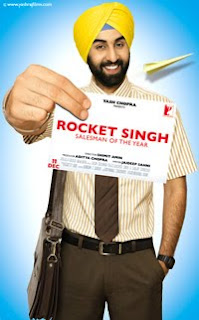
    I haven’t seen this Shimit Amin directed movie yet. But listening to the RJs and after reading the reviews I got this impression that Amin has conceptualised the story around sales and salesman. It is a film about the importance of basic goodness.

    Ditto football. Whether selling computers or football. You need to have your basic elements correct.

    Well, well, well.

    Bob Houghton and Rocket Singh. You might be wondering if it is a wonky idea to compare a Sardarji with an Englishman. Hey, Sardarjis can be equally good salesman like any other Englishman (no racial discrimination, please). Isn’t it? The comparision in this context has been done to show just how good Houghton has been at selling Indian football. A job which could have been done by AIFF’s marketing & sales division. But then Houghton never wanted to rely on them for too long.

    Convinced that football in India can be run clean, Houghton (using his British lineage) asked for what he had ‘wanted’. After taking charge as head coach in 2006, the Englishman had often expressed his displeasure and disappointment with the fact that India was lacking in a good youth development programme which meant there was no credible second string to support the national side. He stressed that junior teams should be sent out for exposure so tat they young players were ready to graduate to the senior team.

    On Sunday at Dhaka, India’s u-23 team won the SAFF Cup which till last year was represented by the senior team. India’s victory is the outcome of a process initiated by Houghton and executed by under-23 coach Sukhwinder Singh. So far, Indian football lacked a definite planning. Vague ideas, too-many-cooks-spoil-the-broth type fundas didn’t help either. Houghton started realizing that there is something wrong. He became a little bold enough to devise a plan thereby allowing the junior teams to play in regional events. Houghton must have visualised this long time back. But like an astute sales executive, he sold the idea to the AIFF bosses.

    Thus, the victory by the U-23 team would have made him happy as it not only vindicated him but will also allow him to experiment further before the Asian Games, SAF Games and AFC Challenge Cup. It is too early to say if the junior development programme based on the Houghton model will end up yielding rich dividends. But the SAFF triumph has given Indian football a ray of hope.

  • Maine Pyar Kiya

    Maine Pyar Kiya

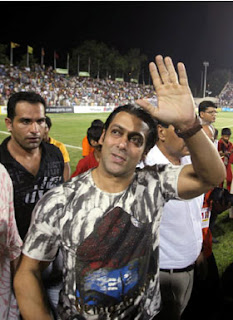
    In the thick and crowded Ambedkar Stadium, Salman Khan’s smiley face popped up on the giant screen almost throughout the evening where India was playing their second successive Nehru Cup final against Syria. Sallu bhai seemed happy to be a football ground and witness an Indian team. Even the TV producer was more content at shouting instructions to his crew to focus the camera on the superstar.

    But amid the cacophony, my mobile phone rang. “Is Sallu still at the stadium?” One of my friends (who however is a Page 3 journo) was deeply interested in Sallu but not about an Indian win. I got a bit angry. But I remained calm. In between, Renedy (Singh) had just scored a gem of a goal from a free-kick to give India the lead. The 30,000 odd fans broke into delirious joy. The noise was defeaning.

    And once the phone rang: “Is Sallu still at the stadium?” This time I got pissed off with this caller. Later the the calls became too frequent. I was loosing my patience more because Syria had equalised. The match was stretching towards the tie-breaker. It was 9.30pm. I was becoming a little uneasy because of edition deadline. But this journo still didn’t keep quite. There was another call. Then I had decided to play a prank. I sms’d. And it read: “Sallu had left the stadium and went to Jama Masjid to break his Ramzan fast. There he would meet a local pehelwan who would take him to a hakim who would prescribe him some desi medicine.”

    The next morning everybody read about India’s Nehru Cup win. There was a small mention on Salman (surprisingly, Sallu never made it to the purani Dilli and Jama Masjid).

    Sorry friend. An Indian victory was important for all of us. Next time, please try and be there to witness the Indian football team.