Blog

  • Is Bob talking sense?


    Last week my friend Riyas (Komu) asked me what do I feel about Bob Houghton’s proposed idea of building Team India for Asian Cup 2011. Well, in the first place I was wondering if Bob is aware of the ground realities. By contracting the 25 best Indian footballers for the next two years and then engaging them with foreign exposure tours will certainly require a great amount of financial support. First question, where would the money come from?

    Having done that (contracting the players) and thus removing the top names from club football would mean that Mohun Bagan, East Bengal or even Dempo will cease to exist as a club. We are not doubting Bob’s footballing knowledge. But we can still expect some sensible ideas from this globetrotting coach. Like in his own country England (though he is based in South Africa), club culture is equally important in the Indian context. The Englishman would have given a second thought before proposing it.

    Experts say a mininum budget of Rs 40 crores is required to maintained this team. So fund is a big issue here because All India Football Federation (AIFF) itself is struggling to generate funds for its own tournaments.
    Besides, we are yet to know who would be central characters in his so-called Team India for the Asian campaign. His skipper (Baichung Bhutia) is in his mid-thirties. Renedy Singh too is ageing. Bob has completely failed to work on a second team which should have been in place after he took over in June, 2006. Some of the players who already deserved a place in the national squad doesn’t know how much more they have to prove themselves. Too much big talk will not really help Indian football. Besides the alleged coterie inside the Indian team with “Bob the CEO” isn’t doing good.

  • Karim’s food and Nayeem

    Karim’s food and Nayeem

    Time, as the cliché goes, really flies away.
    1997. Slowly I was adjusting myself. Having left the city known for its never-ending football madness, I was transported to a city where I came across football clubs. But they just couldn’t match Kolkata. It was only during the Durand Cup’s which brought some relief. Durand Cup showcased stars like IM Vijayan, Chima Okorie, Carlton Chapman, Joe Paul Anchery, Basudev Mondol and others. It was the perfect opportunity to know and understand them, I wondered.

    But Syed Nayeemuddin’s presence overshadowed everybody. If I can recall, it was definitely not my first meeting with him. In 1995 in Calcutta when he was East Bengal coach I had managed to speak to him. But he was and still is monosyllabic. Hence, the interaction didn’t happen at all.

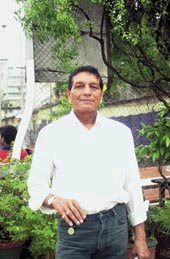
    With the early winter chill in October, Nayeem sahab walked in at the Ambedkar Stadium entrance. The crowd (mostly from Old Delhi) joslted for space. They wanted to talk to him. Share some inputs about the Indian team for which he was chosen as national coach. He wore his trademark spotless white full-sleeve shirt and blue denim jeans. And yes, he sported a Ray Ban sunglass.

    Surprisingly, despite his stature as the national coach, he didn’t leave his one-room accommodation in Hotel Bombay Orient which interestingly is located in the heart of Old Dilli – Jama Masjid and opposite Karim’s. Even much later, he never missed Karim’s food and Old Delhi’s ambience.

    Interestingly, most of my initial interactions with him happened at this food joint. He would often call from a PCO (mobile phones still was not in vogue) or from his hotel and would invite me at Karim’s. I discovered his love for food and he would explain why good food is necessary for footballers who mostly came from lower middle-class families. At his age (he was in early fifties then), his breakfast was sumptuous. It included bheja curry, mutton & chiken burra, naharis at times and roomali rotis. I would often stare at him with open-mouthed wonder. “Footballer needs good diet. It is essential to built a good physique,” he would often remind me.

    Whether you were a journalist fascinated by Indian football, a rookie footballer who just made it to the national team, Nayeem sahab made everyone eat. Khalid Jamil had to finish off a glass of milk before he could say Khuda hafeez to his coach.

    Our conversations would often revolve around football. But if you had waited for him to say something, Nayeem sahab would only lift his face and give a blank look because his fingers got busy to tear a delicious burra!

  • Do we really care for these legends?

    Do we really care for these legends?


    Those guys are so old, you can’t put your arms around a memory” — Guns N’Roses

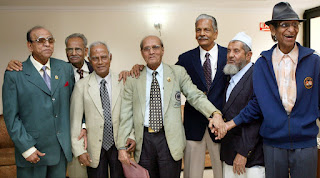
    Those not in tune with Indian football history can easily dismiss Samar ‘Badru’ Banerjee, MA Salam, Zulfikar, Nikhil Nandi, SS Narayan, Ahmed Hussain and PK Banerjee as senior citizens. But when the skipper of that legendary 1956 football team, Samar Banerjee, walked down the memory lane, you knew their ‘star’ status.

    Seven players of the ‘Class of 56’, as they once famously were known as, were felicitated by the sports minister, and all those present were overwhelmed by the humility of these former stars. Gill hugged them and praised their achievements, wondering how these legendary players were consigned to the dustbin of faded memories. So, when a host of TV crews rushed to grab some quick bytes, they felt honoured.

    For some in the establishment, it have been like any other official function. But for these greats, it meant a lot — finally, a recognition from the government. It was an opportunity for them to interact with a much younger generation of mediamen who follow the Beckhams and Rooneys.

    But it was pity to see PK Banerjee, arguably the most popular and who till recently remained the most active member from that great team. Sadly, Pradipda, recently survived a cerebral attack and his right side has been crippled by paralysis. He smiled and said “Beta I can’t move my hand,” when a young journalist asked for an autograph.

    The recognition has come after 50 years. But why? We don’t even know that. May be, the ex-officials in the Federation can explain better.
    Late last year, Peter Thangaraj died. A month later, 1951 Asian Games hero Mewa Lal passed away. Sailen Manna is bedridden. Obituaries were already written on Jarnail Singh, Neville D’Souza, Aziz some years back. Even their father-figure coach (SA Rahim) had died almost forty years ago. Knowing that Rahim was key to India’s stupendous success, we didn’t bother to recognise his credentials. Under him, India reached the semifinals at Melbourne only to miss the bronze, going down to Bulgaria in the third-place play-off.

    Understood, all these gentlemen played in an era which lacked media hype. But then, the Federation could have put in some effort to keep their memories alive. So when Badru read out a two-page obituary on his fellow teammates, we couldn’t help but picturise his team’s exploits in Melbourne. It must have been a great experience.

    Public memory is too short. We forget things easily. What we do today, it’s a bit difficult to recollect them tomorrow. We are worried because we wonder if the future generation will ever remember these footballing heroes.

  • The boat is cruising

    The boat is cruising


    It seems just like other day. The summer of 1981. More than now, football was then the passion that ruled Kolkata’s senses. And I wasn’t immune to its charms.

    My father has always been an avid football fan. Neither the scorching heat nor driving rain could stop him from watching football matches at the Maidan. So it wasn’t surprising that as a 10-year-old, I was hooked to football. I could count on my fingertips the names of the players who represented Mohammedan Sporting, Mohun Bagan or East Bengal during those years.

    It was my dream to watch a match at the Mohun Bagan ground. And it came true in 1981. We drove down from our home at Narkeldanga in North Calcutta to the Mohun Bagan ground. That was the first time I had set foot on the historic ground to witness a match between Mohammedan Sporting and Aryans.

    Mohammedan Sporting won a thrilling match by a solitary goal scored by Kartick Seth. But I was captivated by the capacity crowds on wooden stands rooting for Sporting.

    More than a decade later, a daily visit to the Bagan tent was to become a daily routine for me. Not as a fan but as a sports journalist. I followed the team practice, wait for a couple of interviews, and when that was over it was time for some fish fries, aloo dum, toast and a cup of tea at the Bagan canteen.

    There were often animated and nostalgic discussions on the history of Mohun Bagan.

    And what a history it is. In the winding streets of North Kolkata there existed a lovely bungalow owned by the Mitra family. That bungalow was known as Mohun Bagan Villa. It was in that bungalow where the roots of the greatest club in India grew. In 1889, Mohun Bagan club was formed. This particular street is now renamed as Mohun Bagan Lane. And it is a stone’s throway from our ancestral place at Narkeldanga. A bare 6-7 kms from my place that I can stroll on the historic bylanes of Mohun Bagan Lane.

    Eminent lawyer Bhupendranath Basu, who later on became the president of Indian National Congress was the first helmsman of the club which was then called Mohun Bagan Sporting Club. During its early days, Bagan captured the imagination of the people against British rule. Mohun Bagan’s historic victory against East York in 1911gave them everything.

    Soon the likes of Shibdas Bhaduri and others became household names after the triumph and the victory against East York gave a boost to India’s freedom movement.
    Until the end of the 20th century, Mohun Bagan would go on to win every major tournament in India some time or the other. But trouble started brewing in the early 1990s after the last elections and by 2004, the club had become a disgrace.
    An institution that once united a race to fight against foreign rule, has now been reduced to a society of people with blinkered vision and overriding ambitions. Football and administration have been given the go by, and consequently the club has touched the nadir.

    A player like Subroto Bhattacharya who played only for Bagan during his 17 year career, knows more about the club’s politics than most people. Having coached Bagan to two National League titles and couple of other major trophies, Bhattacharya doesn’t mince his words when it comes to politics in Bagan.

    As I left Bhattacharya’s office at Park Street, I came across another former Bagan player — Prashanto Banerjee. One of India’s finest midfielders, Banerjee, who led Bagan in 1988, says politics is ruining Bagan. ‘The difference between East Bengal and Mohun Bagan is that politics is less significant in East Bengal. But in Bagan it is dominant. That’s the reason they are struggling.”

    Banerjee’s argument has some logic. By 2004-05 Bagan had forgotten how to win. And there weren’t many to cry over the club’s misfortune. Mohun Bagan barely managed to save themselves from relegation in the last National Football League, but their humiliation was almost complete.

    The green and maroon once epitomised tradition, fair play, dignity, virtues. But today they are missing. It can be recalled that in the 1970s a few footballers refused to take part in a tournament. But the then secretary Dhiren Dey declared that Bagan would field its groundsmen. That was the spirit and values the club stood for. That spirit seems to have vanished.

    I also met Chuni Goswami. The living legend of Indian football was a loyal Bagan player who never changed his club. He too was distressed to see his favourite club struggle five years ago.

    But now, it seems, the boat is cruising along well.

    Thanks Karim.

    (In Kolkata, 2005)

  • Indian team’s London visit after 1948

    For nine months of the year, August to May, they spend Saturday evenings watching Premiership matches on television. They’ve looked on enviously as the players there — Beckham, Bergkamp, Zola, Gascoigne — have become household names in India, while they remain virtual unknowns. It must hurt, more so when they see how even average cricketers are treated here.

    So the Indian football team has a chance to redress that imbalance when it sets off over the weekend on its first-ever tour of the UK. The last time an Indian football team went to the UK was in 1948, when Dr Taliremen Ao led the newly independent country’s first-ever Olympic campaign in London. They aren’t under any illusions about the tour’s status there — they’ll be playing two second-grade sides and the Bangladesh national team — but just going to the game’s spiritual home means a lot to them.

    There’s been a noticeable buzz at the pre-tour camp here that’s just wound up. The camp itself was different to others of its ilk; no more monotonous sessions morning and evening with precious little in between. Here, players have spent their time watching videos of the latest matches, including the Euro 2000 games. The All India Football Federation has also, for a change, managed tapes of the two English sides — Fulham and West Bromwich Albion — the Indians will be playing on this tour. The videos are followed by debate and discussion, opinion and analysis.

    The enthusiasm apparently rubbed off on the players, too. Unlike previous camps, at which conversation usually revolved around the awful food or the pathetic accommodation, the new mantra is `homework’.

    Pradipda — coach P K Banerjee — wants his boys to eat, drink and sleep football. Much of the enthusiasm, in fact, stems from the constant chatter of the voluble, affable paterfamilias talisman of Indian football. Banerjee has seen more of football in his days as a star player and star coach than almost anyone else in the country; when he talks, the players listen, and the mood filters through.

    Bhutia is, of course, the team’s resident expert on what it’s like to play in England, having completed a not-unsuccessful first season with Second Division side Bury. He’s an anomaly, though, and that’s the unspoken aim of this tour: To have the English watch Asian talent, which otherwise is largely unrepresented in the country. It’s a long-standing grievance within the Asian community, for whom football is only slightly less important than the ubiquitous cricket. It’s been the subject of an acclaimed book, Corner Flags and Cornershops, which makes the plea that Asians can be as passionate about the game as anyone else.

    There are a million probable reasons for Indian football not achieving much success. There’s a strong awareness among players and officials that this tour, or the next to Korea, will not change the face of Indian football. Nor will India leapfrog overnight from the dismal 115th place it occupies in the FIFA world rankings. They probably won’t even be able to emulate the team of 1948, 1952 or 1956 or 1960 and play the next Olympics.

    One thing is certain, though; when these boys come back, their attitude will be more positive and European football will be knocked a wee bit off its pedestal.

    (In Patiala, 2000)

  • From Iran with a football passion

    From Iran with a football passion


    In the late 1970s and early 80s, this man was the most sought after striker in Indian football. Now, after his playing days are over, Iranian-born Jamshed Nassiri lives another life as a football coach in Kolkata. Nasirri speaks Hindi and Bengali like any Calcuttan. The City of Joy is now his home.

    On any given day, Nassiri could be spotted at the Calcutta Football Club where he imparts knowledge of football to his wards. After his stint with Mohammedan Sporting early last year, Nassiri left for Duliajan in Assam where he coached Oil India Limited. But he couldn’t stay there for long. He missed Calcutta dearly. Soon he came back to his ‘home’.
    “I like India. I found the culture and tradition common to Iran. It was a great experience playing in front of such a massive crowd. That’s the reason I preferred to stay back here.”

    1979. I was barely 8-year-old then. It was not the age of Harry Potter. But of course, Tintin, Phantom and Lothar and Mandrake were there. They were my favourite pastimes. And there was one thing more.

    The myriad football magazines which were so popular in Calcutta during those days. It was in one of those magazines (and I still possess those magazines which could be more than 100) that I saw Jamshed Nassiri for the first time. He didn’t a sport a thick moustache then but still possess the same physique. He was clicked alongwith other Iranian players, Majeed Baskar and Mehmood Khabazi.

    After 16 years, I happened to interact with this Iranian at the Mohammedan Sporting club premises. At that time he took over the reins of Mohammedan as a coach for a brief while. And still today, he looks like the same Nassiri as he was during his playing days. Elegant, fit and agile. Once when I had asked him to exhibit his ‘headers’ which once made him the most dangerous striker inside the 18-yard-box, Nassiri did it with same impetutiosity.

    Though in the initial years it was only Majeed (a member of the Iranian World Cup team in 1978) who dazzled with his brilliant ball play and charisma, Nassiri incorporated his name in Indian football as one of the most devastating striker much later.
    Probably the post 1982 saw Nassiri blossom into a devastating striker. Thrice he scored the match-winner in the successive Federation Cup finals and guided Mohammedan Sporting (1983, 1984) and East Bengal (1985) to triumphs. Nasirri played for East Bengal in 1979, 1980, 1981 and 1985. His second Calcutta club was Mohammedan whom he joined in 1982, and stayed till the late 80s before he retired.

    Nassiri came to India as a student along with Majid and Khabazi to study in the Aligarh Muslim University (AMU). But life had something else in store for him. Along with Majid, Nasirri soon started playing in Kolkata for East Bengal.
    “Before coming to India, I was playing for Iran juniors. So it wasn’t too difficult to carry on with football in India. And moreover, during the Varsity football tournament, I and Majeed scored a lot of goals. Our performance helped AMU win the title,” Nassiri recalled those halcyon days.
    “During the course of the tournament, some of the East Bengal officials were present and they had noticed our performances. And since a clutch of star footballers had left East Bengal in 1979, they wanted to build a decent side. The offer came instantly. And we also decided to take a dip in football crazy Calcutta.”

    After his retirement, Nassiri, who is happily married with his Indian wife and two kids in his modest apartment at Park Street in Calcutta, also left an indelible impression as a coach with Mohammedan Sporting and state team Maharashtra.

    “If India is to reinstate its status as Asian power once again, it needs to focus on the talented players at the grassroot level,” he said. The Iranian is focused to do something for Indian football. He firmly believes that for the development of football one needs to focus at the nursery level. Hence, he devotes his time and attention on the kids ‘only’ in the age-group of 5, 7, 9 at the Parsee Club in the Maidan.

    (In Kolkata, 2005)

  • Enter the Dragon

    Even though India and China have almost similar footballing history and geography the development of the game in two nations is contrasting

    JUST drifting towards the east from the heart of Kolkata and one can discover a China. Located at Topsia near the Eastern Bypass, the place has an exotic name too – China Town. It’s a home away from home for hundreds of Chinese families whose ancestors docked their ships at Kidderpore a century ago. Though their DNA print might show the Calcutta Chromosome but umbilical chord still goes across the border.

    And so last week when the Chinese dragon spread its tentacles to embrace soccer’s promised land — the 2002 World Cup — it was quite understandable that China Town broke into delirious joy.

    Excitement was palpable in the air and, the celebration didn’t lack the vigour of those which were witnessed on the Shenyang streets or at the Tianmen Square moment after China’s historic win over Oman. The only noticeable difference was the sad footnote at the end of this flowery prose. If only the land they had made their home could emulate the land of their origin on the football field.

    India making it to the World Cup! That’s a long shot. But the past records show that India were on par with China but somewhere a long way they lost the way. India boasts of two Asian Games golds and a bronze while China have never stepped on the top of the podium.

    Chi Chu Chang is a typically jaded soccer fan. “China’s World Cup debut will give Chinese soccer a huge boost,” says Chang with a surge of pride. But the disappointment in his tone is hard to hide when he says, “Wish India were also there along with China.” Chang like few of those who keep track of Indian football is aware of the ‘ground realities’ and quickly regrouped himself and added with a sarcastic punch: “May be, some time in the next century India will be there.”

    But, then given the ‘ground realities’ India shouldn’t even dream about a World Cup berth for the simple reason that we don’t really have it in us to to be there.

    China have banked on motivation and national pride. Like the erstwhile East Germans, the Communist China has taught its people the importance of sports.
    Indeed, patriotism is a potent force in modern China today. So much so that the sight of their side crumbling against Iraq in 1993 and Iran four years later in World Cup qualifiers was almost too much to bear.

    The pain was sharpened by the sight of Chinese gymnasts, swimmers, divers, table tennis players and athletes sweeping gold at the successive Olympics.
    Whether it was diver Fu Minxia or Ma Junren’s bunch of talented athletes, China has always been the forerunner, rubbing shoulders with other heavyweights USA, Russia and Japan. In soccer too, China have followed a similar regime — discipline, hardwork and sincerity. And it has paid them rich dividends.

    China achieved it because they are sincere in their approach. We don’t have these qualities in us and that’s why we don’t make it.

    Chinese authorities have injected professionalism into their football only a decade ago and India are still unable to get out of its semi-professionalism.
    Initially, given the enormity of its size, China like Brazil had problems in organising a centralised National League. However, the Chinese sorted out the hindrance quickly and took a giant leap towards the football’s greatest showpiece.

    It was only after the introduction of club soccer in 1994 that the Chinese football slowly and steadily began to reassert itself. These reforms has made all the difference.

    An extensive youth development programme is producing stars of the future. And some them have been exported to the European markets which include Chinese skipper Fa Zhinyi (represents Crystal Palace in English League), Ma Mingyu (Perugia in Serie A) and Yang Chen of German Second Division Eintracht Frankfurt. Others on the wait list include defender Sun Jihai and mid-fielder Li Tie. While Sun already spent a year with English First Division side Crystal Palace, Li has attracted interest from Ajax Amsterdam.

    All this and much more. Chinese football is now draped with success. But if the Chinese federation has laid the stepping stone, it required the finishing touches of Bora Milutinovic. The globetrotting Serbian, affectionately called ‘Milu’ in China, is indeed has become a master at shepherding lesser soccer nations to World Cup success. Before China, the 57-year-old Serb has guided Mexico, Costa Rica, the United States and Nigeria to the finals.

    Milutinovic made all the difference. China selected a man who was sincere and dedicated to his job. And most importantly the Chinese federation has extended their full support. Right from the team selection to the team’s strategy, Bora always enjoyed a free hand. It is something unheard of India with Indian coaches.

    Interference from the non-technical officials has been the bane of in Indian football. Dutta gives an instance how this has affected the game. In 1988 during the Nehru Cup at Siliguri the then AIFF president Khalifa Ziauddin interfered in the team’s strategy.

    So for India, which even finds it difficult to prove his dominance at the South Asian level, the journey to the World Cup seems long and arduous. But the more depressing part is the AIFF doesn’t even know from where to start this journey.

    Maybe, the Chinese success story can give them some clue.

    (In Calcutta, 2001)

  • Soccer balm provides healing touch to Bosnia

    Bosnia, after breaking away from Yugoslavia following the 1992 war, was slowly limping back to normalcy. But even before the newly-born nation could piece itself together, it was haunted by the most sadistic violence ever to visit the Europe since the Nazi campaigns: Ethnic cleansing.

    On top of documented cases of systematic torture and murder in Bosnia, came the charges of a new Serb entity: mass rape. The rough estimates put the number between 30,000 to 50,000. Gang rapes of young girls in front of mothers, fathers, siblings and children, became the order of the day. In fact, rapes became an integral part of the ethnic cleansing and were committed explicitly to impregnate Muslim women and hold them captive until they gave birth to unwanted Serbian babies.

    The leading citizens of Brcko, Bjeljina, Kljuc, Sanski Most, Prijedor, Kotor Varos, Zvornik, who owned a business, participated in the party of Democratic Action or held a University degree, were hunted down and liquidated.

    Naturally, sport became an unwilling victim. Particularly, football, a passion with the Bosnians, was the worst hit by the Serbian atrocities. In the backdrop of war, football remained the only love for the troubled state. It speaks volumes of the tenacity and the fighting spirit of the players.

    The conditions the players faced during the war are too terrifying to mention but they did not give up practising. “It is a miracle,” said Laila Burekovic, who assists her country’s federation in matters relating to international relations and transfer of footballers.

    Little wonder then that goalkeeper Adnan Guso, an undoubted star here in the just-concluded Sahara Cup, stood under the bar with a steely resolve. The towering goalkeeper actually brandished a gun during the war.

    Three other members of the current team, which played the final against Yugoslavia, were also involved during the hostilities. Skipper Dzallaludin Murahemovic, Sead Saferovic and Asmir Ikanovic exchanged and dodged bullets against the Serbian forces during the height of war that commenced after the birth of Bosnia.

    “It was not a war. It was a genocide,” says Laila. After the heat and dust had settled down, the Bosnians concentrated on repair works: to develop the game and put their country on the football map. Funds were raised to rebuild stadiums damaged during the war. Fifa also accorded its recognition in 1993 when it became a separate football entity.

    Two years later, they made their debut against Albania during a friendly match. A 0-2 loss was not encouraging. After all, the fledgling national team comprised ageing stars. Among them was Faruk Hadzibegic, who guided the national team in subsequent years and helped Yugoslavia qualify for the 1990 World Cup in Italy.

    The achievement was something out of the ordinary. In its hour of glory, Laila’s heart goes out to Zelimir Vidovic, a national footballing icon for Yugoslavia and FC Sarajevo, as she recollects the gunning down of Vidovic during the war. She also remembers the scores of other players lost during the aggression. Some fled the country, maimed and killed by the horrendous violence.

    The call of the hour, as Laila puts it, is to look ahead. Bosnia have held their own in soccer and continue to feature prominently in basketball, handball, volleyball and winter sports.

    Bosnia’s initial results in international football turned out to be rather depressing. Heavy defeats to Greece (0-3) and Croatia (1-4) in 1996 in the World Cup qualifiers spelt doom for the nation’s footballing aspirations. They narrowly missed a Euro 2000 slot owing to injuries and suspensions.

    However, under the enterprising Faud Muzurovic, a stalwart of prominent FC Sarajevo, the team began on a confident note. Eleven new faces took to the pitch against Slovenia and won. And the flow of confidence enabled the side win two of their last three matches of the qualifying programme, ending with a 3-0 demolition of the mighty Denmark in front of the 40,000 roaring spectators in Sarajevo’s Olympic Stadium.

    Bosnia, with three wins from eight outings, may find gaining a spot in the World Cup difficult. But the side, dotted with several players from Europe’s top leagues, is capable of surprising the best in business. Hence, the Bosnians will need some watching as the 2002 World Cup qualifiers hots up.

    Even a World Cup spot now is a distant dream. But three wins from eight outings has provided ample encouragement.

    (In Calcutta, Jan, 2001)

  • Crumbling walls of Delhi football

    Crumbling walls of Delhi football


    Surrounded by crumbling walls and three surviving gates, the still vibrant old Delhi, built during Mughal emperor Shah Jahan’s reign, is very much a city within a city.

    A labyrinth of serpentine lanes crowded with rickshaws, it is lined with 17th-century havelis whose once ornate facades are now defaced with rusted signs and sprouting satellite dishes. This decay symbolises the dwindling fortune of football in the Walled City, a sad state of affairs since it once used to dominate Capital’s soccer scene.

    In the halcyon days, driven by passion for the game, old Delhi traders and businessmen did not mind diverting their business profits into football, helping the emergence of well-known clubs like City Club, Shastri FC, Youngmen, Mughals, and Indian Nationals.
    While the clubs flourished, the game attracted the middle-class. Such was the clubs’ appeal that even common folks came forward with contributions as clubs like Indian Nationals or City Club became a part of their lives.

    Today, these clubs are up against harsh reality: How to carry on their legacy without funds? Passion alone cannot take them forward. The clubs have ceased to enjoy patronage from the locals as well. And businessmen no longer support them as they used to.
    Most of these clubs spend from their own pockets. Gone are the days when these clubs would be treated with handsome contributions from Delhiites.
    “It’s definitely good for the game here. But there should be more takeovers like this,” said a Delhi Soccer Association official.
    Today, a top club needs about Rs 10 to 15 lakh to run its affairs. It’s a huge amount by Delhi standards as football is still a poor man’s game here. But still, some clubs are able to manage the money required to run their affairs which indicates there are takers for the game.

    Most of these clubs depend on their communities for financial support. But with football’s charm slowly fading, even old fans now chose to stay away.

    One of the main reasons for the decline of soccer in the Capital, club officials feel, is that DSA does not have its own ground. “Ambedkar Stadium (which usually hosts important football matches) is easily accessible for fans from the Walled City. But ever since some games have been shifted out of Ambedkar, fans have found it difficult to follow their teams,” said a club official.

    In fact, absence of proper grounds have pushed Delhi football way behind the rest. There was a time when people used to kick a ball on the roads, in the parks and in empty areas which have now been taken over by high-rise buildings.

    “In old Delhi, if someone played football, others watched him. And gradually followed him. That was how many youngsters took to the game,” said an old fan who has been following Delhi football for decades.

    With some leading corporates showing interest in Indian soccer recently, there has been something to cheer about for the soccer fan. But how will the lot of Delhi football improve, no one knows.

    (In Delhi, 2007)

  • Renedy still going strong

    Renedy still going strong


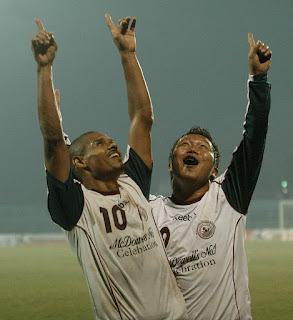
    Dada sorry for not being able to return your call the other day,” Renedy (Singh) seemed apologetic. But he was quick to add, “How would you rate my performance against Mohun Bagan?”. For the record, Rahim Nabi scored one of his two goals from his freekick in East Bengal’s memorable 3-0 win over Bagan in a crucial I-League match in Kolkata.

    Whether its his vicious free-kicks or scorching runs down the left, the Manipuri medio hasn’t lost that element of touch even after completing a decade in football. A regular for the Indian team since his senior debut in 1996, Rennedy appears the most settled player after Baichung Bhutia in an Indian side that has witnessed constant change in the last couple of years.

    But for him the last two years (2005, 2006) had been pretty difficult. He was out of the national squad for a year-and-a-half followed by a niggling knee injury which forced him to leave the glam world of Calcutta football, and later found himself out of favour with the national coaches. Still, Renedy didn’t threw in the towel.

    In 2004, the Manipuri-born medio scored his fourth international goal against Singapore in a pre-World Cup qualifier. Close on the heels of that stupendous show, he earned an impressive club deal; Mohun Bagan appointed him their captain in that year. But things didn’t turn out to his expectations.

    Mohun Bagan was his last big club in 2004 before he joined JCT. He felt that he was forced to leave Kolkata as things weren’t that conducive in Bagan. Besides the club didn’t clear his dues. Things weren’t on his side.

    True. 2004 had been a topsy-turvy year for him. Bagan released him midway and he was reduced to a non-entity in Kolkata football. He wanted to join East Bengal but the strange transfer contracts between Bagan and East Bengal had shut the door on him — he was out of football and out of club. After a brief spell in one low-profile club in Kolkata, Rennedy finally took the toughest of all decisions: bid adueu to Kolkata football.

    Later Rennedy found solace in National colours in 2006, though it came after two years. “In 2005-06 I had performed well with JCT. But still didn’t get a national call. But finally, I guess the justice has been done to my hard work.”

    Far away from the hype of Kolkata football, life became a wee-bit difficult for Renedy in Phagwara. “JCT have the best of football facilities. Bt it was a new place for me. And like any newcomer it was becoming tough to adjust.” Yet, he survived the toughest of moments — both as a player and an individual — and seldom lost hope for a revival.