Blog

  • The Fab Four

    Manoel M Flores Junior (Brazil), Gonzalo Bossart (Chile), Pedro Rodrigues (Portugal) and Taufique Ahmed (a former AIFF official) are all in their early thirties. They have different backgrounds. But all four are linked to football. Currently they are working on a project that dwells on Indian football at the FIFA International Master in Zurich. The combo of ideas emanating from a Brazilian, Chilean and a Portuguese and guided by an Indian, if assembled together and endorsed by FIFA later could well become a guideline to resuscicate Indian football by forming a successful and independent league in the line of EPL (England) or La Liga (Spain).

    “In India there is only one sport to compete with. While football in America has to compete with four major sports, in India the scenario in different,” Junior said.

    “If you compare Indian football with Brazil, Chile and Portugal with their own established leagues, the attempt to create a successful league is seen by some people almost as impossible. This is exactly where we come in. We believe India has got potential in becoming an important stakeholder in world football,” explained Junior, who heads a commercial operations responsible for football telecasts in Brazil. Besides, the Brazilian also control and coordinate the delivery of commercial advertising in TV channels.

    But Chilean Bossart is a practicing lawyer who earlier was associated with Chilean government as head of Control Unit and Sports Organizations, ministry of justice, at the Legal Person Department. He also worked with legal department of National Institute of Sports of Chile. Indian football have already entered into a tie-up with Portugal since 2006 and the Indian team have been touring since then. But are these tie-ups going to bring about any changes? “One of our goals is to analyze how effective are these tie-ups. If any of its aspects can be applied in the formation of a league. The exchange of knowledge with Belenenses (one of Portugal’s top clubs) is sure to have an impact on Indian football,” said Pedro Rodrigues.

    Junior believes that a Diego Maradona visit will not change Indian football. “Presenting celebrities is certainly an effective marketing strategy but it’s not everything. A mix of initiatives ranging from community partnerships and infrastructure development to media relationships will all have to be dealt with.”

    Despite the hurdle, there is a ray of hope. “With only one sport dominating, India allows more room for another to be introduced successfully. Just to remember that we are not talking about any sport, we are talking about the world’s most popular game,” explained Ahmed.

    (In New Delhi, 2009)
  • Soccer a big hit in rural Orissa

    One may have heard abour hockey being played in tribal areas of Orissa. But the state’s non-descript river-locked villages of Kendrapara district has witnessed a silent soccer revolution has been taking place. These handful of villages have been throwing up women footballers of class regularly over the last four years, five of whom have already donned the India colours in international tournaments.

    In fact, the Aul-Rajkanika belt is now being considered as the nursery of women football in Orissa from where talents are being picked for training in state-run sports hostels.

    Sixteen-year-old Sushmita Mallick recently accompanied three other young girls of the area to Kuala Lumpur to represent the country in an age-group tournament, virtually pushing aside the prevalent caste and gender bias.

    Sushmita, along with Sangita Patra, Suprava Samal, Bijoylaxmi Sahu and Alochana Senapati have broken new grounds, said Debendra Sharma, president of the Kendrapara district committee, who is considered the chief patron of women’s football in the region.

    Sharma, for whom football is a passion, is also vice-president of the state Women’s Football Association. It all started happening after a series of exhibition women’s football matches were organised at the mini stadium at Aul in 2002. A novel concept to the local people, it evoked much enthusiasm and curiosity among young girls.
    “After the completion of matches, we invited the girls to come forward to participate in a training camp. The response was unprecedented as over 40 girls, accompanied by their parents turned up for the training session. They have not looked back thereafter,” Sharma said.

    While five of the girls belonging to Malapatana, Giribandha and Goudapatana villages have already become internationals, 13 girls from the area have been chosen for the state under-19 and under-16 teams, Sharma said.

    Seeing the talent the girls had, the state department of sports deputed a coach to train them. Initially, the physical education teacher of a local college volunteered to coach the girls. “But later we recruited a trained coach, Chittaranjan Patra to nurture these talented girls.”

    Sharma said several hurdles were encountered in training the girls as they were mostly from dalit background and had little to look forward to their future.
    Some of those who encouraged the girls to take off on an unknown career in sports even spent from their own pockets to keep the training programme running. But when the girls began to excel on the field, contributions came voluntarily from other sources. “Though the initial days were hard, the burden eased with majority of the footballers being accommodated in the government-run sports hostel at Bhubaneswar,” he said.

    (In Kendrapara, Orissa, 2006)

  • Tribute from an artist

    Tribute from an artist


    A boy stitching a football — an universal emblem of aspiration. This vibrant pose in the slums of Brazil was immediately captured by Riyas Komu, an accomplished Mumbai-based painter and a photographer. Even after establishing himself as a renowned painter, this Kerala-born artist hasn’t forget his first love: football. He wants to live with the game along with art.

    But Why he has chosen Indian footballers as his subject. “Indian football has brought in some fame through their modest effort but we don’t have time to attend them. The players are not to be blamed for it. They actually struggle with their lives than the game.”

    Riyas grew up playing football and lived with it till the age of 21 in Kerala. And then he moved to Mumbai to pursue art. His work refers to the paradoxes of the urban situation where there is glamour and abject poverty. He is compassionate yet it is laced with cynism.
    “I realised the players’ issues from an artist’s point of view. My art revolves around socio-political issues. I decided to give first preference to players’ issues because I’ve found they are not treated well despite being the national players,” he added.

    So while Habibur Rahman posed with his modest bike on the Hooghly bridge or NS Manju on a Kolkata street, Riyas was happy clicking them from a difficult angle.

    “As an artist, I want to speak for these players through my works. Its not just a subject for me. I see it as my responsibility!”

    The exhibition was divided into four parts and titled ‘Mark Him’. The first half was held in Mumbai in 2007 followed by the second half in Kolkata in 2008. So while he traveled extensively from Goa to Kolkata and in Mumbai, one can gauge his sincere effort to do something for footballers who are usually left behind in the publicity market.

    “When I finished my art training in 1999 and came to stay at Borivili, my interest in the game was revived. But I found that most of these footballers don’t even get a good room to sleep.
    “They should not miss anything because they play a game where they have to “pass it around”.

    (In Delhi & Mumbai, 2007)

  • Has Kolkata football slowly walked into the sunset?

    I can accept failure, but I can’t accept not trying — Michael Jordan

    The rickety wooden stands at Mohammedan Sporting ground in Kolkata hits you on the face. It tells you a tale of a series of failures the century-old club has been battling with. After the club logged themselves out of the XIth National Football League, Sporting fans are now reeling under a certain kind of fear psychosis.

    Sporting’s story isn’t an isolated case. East Bengal and Mohun Bagan’s pdestrian show in recent years have re-established the hard-core truth about Kolkata’s gradual decline as a powerhouse. There were early warnings. But then the Kolkata clubs overlooked the imminent danger as they wore arrogance on their sleeves. Because in Kolkata, officials always beleive that ‘tradition and history’ would sail them through.

    But then the combo effect of ‘history and tradition’ has been proved redundant in their bid to resurrect an image lost long back. Sample this. The last time a Bengal team won the National Championship for Santosh Trophy was in 1998 while after 2003-04 no other Kolkata club has been able lay their hands on NFL crown.

    A quote on Kolkata’s football culture from none other than FIFA President Sepp Blatter will put things in the right perspective. “I visited three clubs. One (Mohun Bagan) which was over a hundred years old. It was established even before FIFA in the past century. Its infrastructure is from that century only.”

    While Dempo, Mahindra United or even JCT showed exuberance and committment every time they stepped on to the field, Kolkata clubs kept themselves busy with debilitating issues off the field.

    At one stage, it looked like East Bengal would pip frontrunners Dempo and Mahindra in the NFL title race. But ideological differences between chief coach Carlos Roberto Pereira and tecnhical manager Manoranjan Bhattacharya put paid to their hopes of a possible fourth title.

    At Bagan, the scenario was even worst. They got trapped in their self-created complications after rebellious streak in their senior players inlcuding Baichung Bhutia and Jose Ramirez Barreto saw four coaches made the exit midway into the NFL season!

    With better-organised teams like Dempo, Churchill and Mahindra virtually outpacing Bagan or East Bengal, justifiably then, should we still refer to Kolkata as the ‘Mecca of Indian football’. Because like the holy Mecca’s geographical position, Indian football too has shifted to the West.

    Probably the best quote on Kolkata football came from Blatter’s counterpart in Asian Football Confederation (AFC), Mohammed Bin Hammam. “We have seen your three clubs. We know you have the history. But what is the future?”

    The AFC president’s evaluation was correct and to the point. After all, ‘past history and tradition’ in no way can lift the game from where it is today. No wonder then the clubs’ future seems to be heading towards an unidentified zone. People have lost interest in games while players have lost their will to play and club officials are not too keen to run the game.

    Added to the woes is the amateur set-up where unprofessionalism runs deep in the football system. Officials often blame it on sponsors or players. When none of the blame seems accurate, coaches are made scapegoats.

    In the 70s and 80s, Bengal was considered to be the supplyline of footballers. Using informal network of scouts, dedicated club officials searched for talent. There was dedication and an intense love for the club. But none of these happens anymore as officials prefer ‘dubious agents’ to do the overseas scouting during the transfer market. In this way, money is made from overseas players’ by the officials and from anything that represents the club. Be it commissions for players’ kits or others.

    Then there is serious lack of investment in its youth teams. If the first guilt of not having full-time youth structure was outrageous, then fielding overaged players made a total mockery of city’s football setup.

    Has Kolkata football slowly walked into the sunset?

    (In Kolkata, 2007)

  • Danny, Tinkitam & Baichung

    Danny, Tinkitam & Baichung


    Tinkitam won’t sound like some place on Mars if for those who keep track of
    Indian football. Set against the backdrop of the majestic Kanchenjanga, it is a place almost ethereal in beauty. But getting there is almost as difficult as solving some cryptic clues. With the early morning cold wind often numbing your senses and the rocky path sometimes making your knees wobble, you might throw in the towel. But then the challenge is worth taking only because of Baichung Bhutia.

    Forget about Tinkitam’s latitude and longitude, locating it on the atlas would definitely require a magnifying glass. The place is virtually cut off from the satellite world. Telephones, cable networks or even the cacophony of vehicles are yet to make any inroad in this sleepy hamlet firmly placed at the foothills of Kanchenjunga. Silence spreads like a contagion as you weave past the lush green cardamom plantations on either side of the two kilometre stretch which leads to the Indian captain’s village.

    Yet, the passport to this remotest village happens to be Indian football’s only superstar — Baichung. And even if you are not comfortable with the local Nepali dialect, simply roll out the words, `Baichung, Baichung’ and you would be heading towards his home.

    After Danny Denzongpa, this tiny Himalayan state got Baichung as their most adorable celebrity. And the Sikkimese are quite elated. Why not? After all, heroes are rarely bred in the mountains where life is extremely hard and steeped in poverty and backwardness.

    In the early nineties, a precocious talent emerged from the obscurity of a relatively unknown village called Tinkitam to do wonders with that spherical leather object called football, Short and stocky, Bhutia soon became a rage with the hillmen. His import to the motherland of soccer — England — in 1999 has given his modest village a shot in the arm. No wonder, Tinkitam instantly gained international fame.

    In fact, the Sikkimese has even emulated his ‘Grandpa’ Danny in terms of hero worship and popularity; and the hillmen’s unbriddled joy and happiness is expressed through football, and Bhutia can claim to be a trendsetter.

    In Tinkitam and elsewhere in his state, Bhutia is more than a football star. He is the Little Buddha. Or even a Karmapa whose hero worship is almost legendary. You may not come across any `Baichung shrine’ but the Sikkim Government has paid obeisance to the celebrity in the form of a stadium at Namchi, 45 minutes drive from Tinkitam. Baichung Stadium at Namchi stands tall for posterity to reminiscence his impressive track record in a sport which sadly has few takers in India.

    True, Bhutia hasn’t won an Olympic or a World Cup medal for India. Yet, he stands tall among his contemporaries because of his sheer tenacity to achieve against all odds. And that’s may be the reason why every hillman whether Bhutia, Nepali or a Lepcha tries to identify himself with him.

    For just as Jesse Owen’s was the Blacks answer to German superiority in athletics, Bhutia is the mountain’s answer to the plain’s mastery over football.

    “Earlier, the parents used to push their children into studies. But ever since Bhutia became a star things have changed. They now take pride in pursuing football as a career,” said Samteng Dorji, who himself takes part in afternoon practice seesion at the Baichung Stadium.

    At Bhutia’s school at Tashi Namgyal Academy, Sikkim’s most prestigious and premier institutions in Gangtok where he was sent as a nine-year-old, students pin up his pictures in their hostel room. Because Baichung spells pride. “He has earned a lot of fame,” exclaims a hotel boy, Nim Tshering, who recalls the young striker practising on the hard and sandy Palzor Stadium.

    Bhutia in fact personifies the essence of the Sikkimese character — honest, modest and simple. At the core of Bhutia becoming a cult figure, an icon, is essentially the mountain people’s endless struggle against hostile surroundings. His success story has done wonders for the hillmen to take up the cudgels and weave more success for their state.

    Bhutia’s success story has even boosted the state’s tourism industry. In an effort to attract more tourists, the Ravangla Tourism Centre proudly displays in its brochures ‘Come and visit Tinkitam, Baichung Bhutia’s birthplace.’

    Bhutia’s parents — father Dorji Doma and mother Sonam Topden — are proud of their son. Though they are not aware much about his exploits, yet they are contended that Bhutia is still the most res;pected and demanding footballer in the country. “Bhutia has done us proud. He is there right at the top,” said Topden, Bhutia’s mother, with a surge of pride by pointing her finger to the tip of the Mt Kanchenjunga.

    (In Tinkitam, Sikkim, 2001)

  • With love from Iran

    On an insipid Saturday morning in the Capital, Jamshed Nasiri’s tiring eyes (he is on a whirlwind tour of the country) lit up after watching young footballers from Capital’s renowned schools turn up in expensive jerseys and kits. But Nasiri isn’t so surprised. After all, most of these participating teams are from Capital’s renowned private schools.

    “Watch this boy,” he points to a Air Force School player. “Watch his ball control. He is a very skillful player who made it to the Arsenal last year,” he added.

    A trip to Arsenal is a dream which every young footballer will look forward to. And Nasiri was here to spot talents (only 3-4 players per city) find a place in the final 30 which will be pruned to 16 before making it to Arsenal to represent India.

    This former East Bengal and Mohammedan Sporting star talks about developing a football culture in India. He doesn’t even mind working with youngsters. “I can tell you there are good talent in the country. We only need to spot and groom them. Tata Tea-Arsenal venture is only a modest effort to promote these players,” he shares his experience as a spotter.

    But when told that in cities like Delhi, kids from affluent families play soccer just for status symbol, Nasiri smiles. “At the Sir Dukhiram coaching centre on the Maidan in Kolkata, I know small kids who play with tattered boots. They eat only chana. Still they are so passionate about football,” he draws a comparison between the two different socio-economic conditions.

    After having played the game at top level, Nasiri explains why seven-a-side game should be strictly adhered to. “In a full-team game, players waste time. But seven-a-side or five-a-side events keep players busy because speed and skill are vital,” he said.

    But will this abridged format mar the very essence of the game? “No,” says Nasiri, adding, “For such games, one needs more skill and speed, which is good for competition.”

    Besides keeping a tab on the teams’ performances, Nasiri doesn’t forget to talk about Delhi football. “Capital’s football is better now than what I saw during my playing days. Atleast ND Heroes, Indian Nationals and Simla Youngs are trying to introduce professionalism,” he said.

    “If India is to reinstate its status as Asian power once again, it needs to focus on the talented players at the grassroot level,” comes the suggestion from this Iranian who now takes his caravan to Lucknow, Chandigarh and other cities before selecting 30players for a session with Arsenal coaches.

    (In New Delhi, 2009)

  • Kashmir and its women footballers

    Kashmir and its women footballers


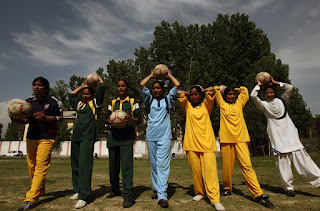
    Just adjacent to the school campus, CRPF jawans keep a vigil from their hideouts but Hina and her friends are hardly bothered by their presence. Instead, these Kashmiri girls are enjoying themselves to the hilt, by playing the world’s most popular sport — football.

    Interestingly, there is no fatwa against Hina, Ruksana, Nazia… who are dreaming to become footballers and, who practise in a school ground in Srinagar’s posh Rajbagh area which is near the Bakshi Stadium which recently hosted the National Football Championship.

    Gun-toting securitymen notwithstanding, presently, one does come fact-to-face with the fact that the Valley is moving forward on many counts, as evidenced by the regular participation of girls in football.

    At the Rajbagh Girls’ Secondary School, around 45 girls from different schools turned up almost everyday for the local selection trials. After the trials, the team will travel to Leh next month for the U-19 state championship. “They are highly excited at being part of a football team,” said coach Mushtaq Ahmed Dar.

    No hardliner has yet spoken against the presence of women in a ‘manly’ game. But the girls prefer to be in trousers and not in formal football shorts. “There are no strict guidelines on the use of hijabs. Some use it, others don’t. Football is the key word,” asserts Dar.

    Whether, it’s making an accurate pass or taking a freekick, the girls seemed focused on training. Also, football seems to have made them bold and confident. For the record, though, Jammu & Kashmir has not yet seen an exclusive women’s sports events.

    “Earlier, Kashmiri Muslim families had an orthodox mentality. During and after militancy, most girls opted to study outside the state. It helped change their mindset. That’s why most families here do not mind sending their girls for sporting activity,” feels Humaira Showkat, who is pursuing her PhD in sociology from Aligarh Muslim University.

    Dar explains: “TV has changed our society. After watching some women sports events, these girls have been encouraged to dream. Though they are aspiring to be footballers, most of them idolizes tennis star Sania Mirza because she is the only celebrated Muslim sportswomen in our country.”

    When I asked some of these girls if they were uncomfortable playing a game dominated by men, they felt there should not be any gender bias, particularly in today’s progressive society. “Girls are excelling in various fields and there is no reason why we should not participate in football too.”

    The recent football National Football Championship in Kashmir has given them a fillip. They now believe more than before that the situation is conducive for football in the state.

    (Srinagar, June 2008)

  • Football Comes Home

    Football Comes Home


    It was in the year 1982 that Indian football woke up to stark reality. With the World Cup semifinals and final beamed live from Spain for the first time ever, aficionados with open-mouthed wonder realised how obsolete Indian football had become. For them, the opportunity to watch world class action on TV was just like taking a break from their mundane daily routine to venture into the cool climes of a hill station.

    But much before the World Cup telecast happened and EPL had made inroads into Indian drawing rooms, the inaugural Nehru Cup in 1982 at Kolkata had already ‘exposed’ the standard of Indian football. The event, meanwhile, was so popular that across Kolkata (then Calcutta), the Nehru Cup became the subject of all conversation.

    But it was not surprising then. The Kolkata league and other domestic events were becoming too tacky to follow, and the Nehru Cup was a refreshing offering. Without doubt, witnessing the Nehru Cup became much more exciting than watching homegrown ‘stars’ in action.

    Nobody had imagined that the Nehru Cup would be a runaway hit in its very first year. The pace, the style and the approach of the visiting teams clearly differentiated it from Indian football. Though the loyalty for Mohun Bagan or East Bengal was still there, Kolkatans switched their allegiance when it came to Nehru Cup.

    After all, who wouldn’t have been mesmerised by sorcerrs like Enzo Francescoli Uruguay), Laszlo Kiss (Hungary), Jorge Burruchaga (Argentina), Nery Pumpido Argentina), Euzebiusz Smolarek (Poland), Rinat Dasayev and Alexei Mikhailichenko both Russian)?

    And, yes, who can forget the eccentric genius, the Argentine coach Carlos Bilardo, who was best remembered for his expulsion from the bench by the referee following a heated argument?

    Probably, that was the only time when the All India Football Federation (AIFF) brought quality international teams for the Nehru Cup. As the years wore on, particularly in the early 90s, the federation lost both passion and motivation to continue with its only international tournament.

    Cut to the present, and the revival of the ONGC Nehru Cup could have happened much earlier. Lack of international outings, both at home and away, and a serious lack of initiative from the federation had sounded the death knell of an Indian team which always relied on ‘promise’. No wonder then, the success-starved national squad slipped down the FIFA rankings.

    But thanks to chief coach Bob Houghton (the Englishman made AIFF bosses realise the importance of international events) that ONGC Nehru Cup is finally taking off once again, after a decade’s hiatus. But then, this year’s event, which will see five Asian nations in action, could also have included a top Asian team or one from Latin America or Europe. With the contesting nations ranked well outside the top 100, the event definitely won’t rank among the best of the 12 editions held so far.

    However, it’s not known if the federation was keen on continuing with the Cup anyways. Earlier, it was an annual affair till 1989. Then, it became a biennial event. And after 1997, when India finished third, the Nehru Cup went off the radar completely.

    In the past, the AIFF had cited paucity of funds and other reasons to ignore the Cup’s revival. But now that the corporates have evinced interest in football, the federation will do well to enter into a longterm agreement to keep the event afloat. Else, it will once again be packed off like it was 10 years ago.

    (In New Delhi, 2007)